New York City is the latest in a string of global cities to launch successful congestion pricing schemes.


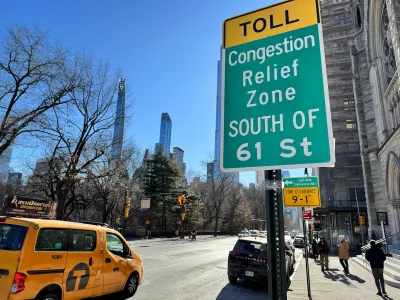
In the wake of New York City’s long-awaited adoption of its congestion pricing program, Dan Zukowski highlights four other global cities that have implemented road pricing.
The first city to establish a congestion pricing scheme was Singapore back in 1975, when a tax for entering the city led to a 20 percent drop in traffic in months. The city later upgraded to an automated system that dynamically adjusts tolls based on location, time of day, vehicle type, and travel speed.
London launched its congestion pricing scheme in 2003, and quickly saw opposition drop as Londoners experienced the benefits of reduced traffic and faster buses. Three years later, Stockholm launched its own program, using the revenue to expand its transit system. And “Milan started charging vehicles based on their emissions in 2008, then replaced that program in 2012 with a congestion charge on weekdays at certain hours. Within two years, traffic in the zone known as Area C decreased by 28%. Traffic collisions involving injuries declined over 26%, and CO2 emissions were down 35%.”
The success of New York City’s program, which led to significant reductions in traffic and improved bus travel times, could encourage more U.S. cities to try it.
Read the full story: 5 cities with congestion pricing

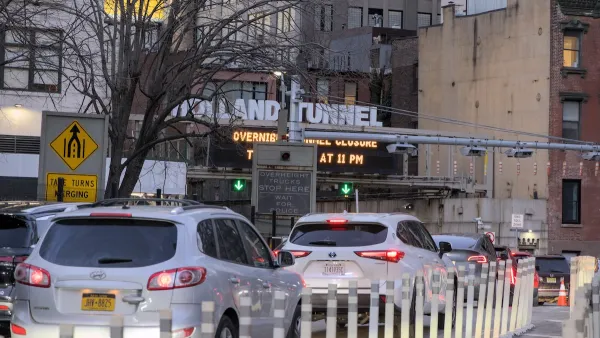
NYC Congestion Pricing Continues to Show Positive Results
While the Trump administration attempts to revoke the program’s federal approval, congestion pricing continues to reduce traffic, speed up bus travel times, and improve air quality in Manhattan.

NYC Congestion Pricing Goes Into Effect
The long-awaited congestion pricing program began on January 5.
Congestion Pricing Compromise?
A CBS News New York report suggests that Gov. Kathy Hochul is considering lifting her ‘indefinite pause’ on the Manhattan congestion pricing project if the $15 toll was lowered. Litigation threatened by the NYC comptroller may be a factor.

Planetizen Federal Action Tracker
A weekly monitor of how Trump’s orders and actions are impacting planners and planning in America.

The state-sanctioned urbicide of Austin
People don’t kill cities. Freeways do.

Colorado’s Largest Data Center Could Rise Next to Homes — Without a Public Hearing
The proposed campus would consume 11 times the power of Denver International Airport; as it has across the country, opposition mounts.

Judges permit Denver to divert 77,000 acre feet from the Colorado River for reservoir expansion
Overuse and climate change have caused the Colorado River’s water levels to plummet.

Amtrak, CN end decades-long dispute with eight-year agreement
The new operating agreement establishes an updated framework for the companies to work together, including processes to resolve disputes.
Raised interest rates may kill financially vulnerable construction projects
The chief economist at ConstructConnect warns that if construction project owners are negatively impacted by the raised rates, it could result in delayed payments to contractors.

FREE Course: Walkable City 1: Why Walkability?
After describing his path towards focusing on walkability as the essence of good planning, Jeff Speck marches through his five principal reasons for making more walkable places.
Reinventing Malls: Planning Alchemy—Turning Gray Fields Into Gold
The course focuses on the opportunities and imperatives that shape reinvention of mall sites.

KFH Group Inc.
Greater Baltimore Committee
Eagle County Government
The Architects Foundation
University of Cincinnati Online
The Pocatello Development Authority
The Urban Renewal Agency of the City of Pocatello