Recently enacted legislation promotes offshore wind projects, solar energy, and electric vehicle infrastructure.


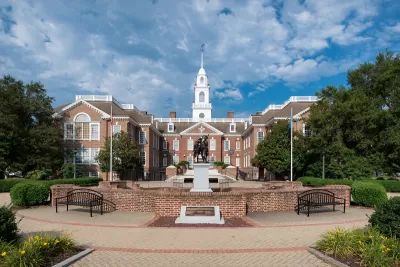
In an article for the Delaware News Journal, Molly McVety outlines five new state laws related to climate change, land use, and transportation.
“SB265, which has made its way through various Senate committees and representatives, creates a framework for Delaware to solicit and build offshore wind projects along its coastline.” The bill requires that new offshore projects have a term of at least 20 years and keep power at below 110 percent of average cost for customers.
Two bills promote electric vehicle adoption. “House Bill 9 sets a goal that by 2040, all state-owned passenger and light-duty vehicles will be a form of zero-emission vehicles, either battery electric, hydrogen fuel cell or a plug-in hybrid.” Another law will create a financial assistance program for EV supply equipment and installation costs.
House Bill 402 requires new schools and state buildings over 50,000 square feet in size to prepare part of their roofs for solar panels, while Senate Bill 237 calls for comprehensive plans to include strategies for climate resilience in any updates. “Senate Bill 237 also will require that modes of transit that do not rely on automobiles, like walking trails or public transportation, as well as their designated evacuation routes are considered to the fullest extent.”
Read the full story: New laws enacted relating to EVs, land use planning and climate change. Here’s what to know
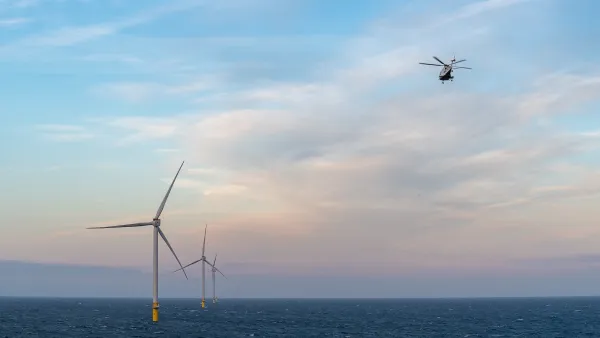
California presses forward on offshore wind
The state is taking steps to prepare its grid and port infrastructure for offshore wind projects despite the federal government's pushback on the technology.
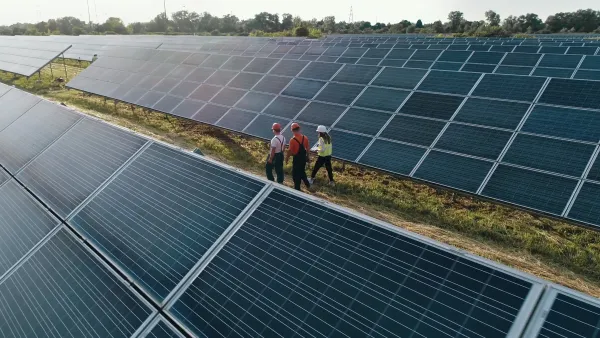
Study: States approved 90% of renewable energy projects between 2018 and 2024
Ohio had the highest rejection rate for wind and solar proposals.
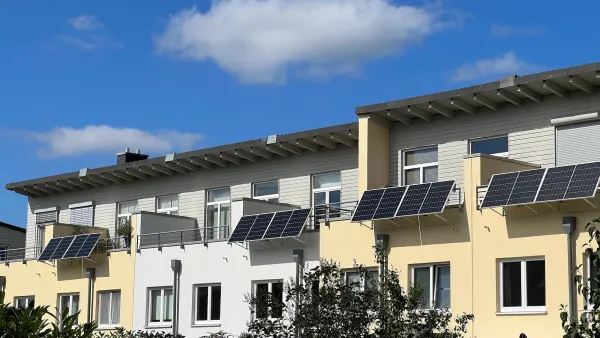
28 States and DC Could Legalize ‘Balcony Solar’
Plug-in solar panels, which are becoming popular across Europe, live in a regulatory gray area in the United States.

Planetizen Federal Action Tracker
A weekly monitor of how Trump’s orders and actions are impacting planners and planning in America.

California plans to bury El Niño’s downpour
If the state plays its cards right, it may be able to store a billion acre-feet of El Niño’s water in aquifers.

Desperate measures: Advocates weigh draining Lake Powell to fill Colorado River
Draining the reservoir could reduce evaporation losses by a couple hundred thousand acre-feet.

Los Angeles just elected an urban planner as its mayor
Transportation analysts are optimistic that Raman will be more aggressive in addressing transit issues than Bass.

Mamdani’s pied-à-terre tax survives legal challenge
A panel of judges found that the plaintiffs failed to demonstrate injury as a result of New York City's implementation of the tax.

Eastern Nebraska is running out of electricity
Data centers and electrification are straining eastern Nebraska’s grid, throttling economic development.

FREE Course: Walkable City 1: Why Walkability?
After describing his path towards focusing on walkability as the essence of good planning, Jeff Speck marches through his five principal reasons for making more walkable places.
Reinventing Malls: Planning Alchemy—Turning Gray Fields Into Gold
The course focuses on the opportunities and imperatives that shape reinvention of mall sites.

City of Rosemead
Rutgers University, Edward J. Bloustein School of Planning and Public Policy
One Hundred Miles
University of Michigan School for Environment and Sustainability (SEAS)
Hunter College, City University of New York (CUNY)
The Architects Foundation
City of Cambridge
Montrose County
The Pocatello Development Authority