State lawmakers seek to change Oregon e-bike laws following the death of a 15-year old last summer.



The Oregon House of Representatives passed a bill on Tuesday that would create three classes of electric bikes based on motor type and speed capabilities and ban e-bikes for anyone younger than 16. The legislation, introduced by Rep. Emerson Levy, is a “scaled-back version of what she originally proposed as Trenton’s Law, named for 15-year-old Trenton Burger,” who was struck by a van while riding an e-bike last June, reports an article in the Oregon Capital Chronicle.
The three e-bike classes defined in the bill mirror those in 41 other states that have adopted a three-class system for regulating e-bikes:
- Class 1 e-bikes only provide assistance when a rider is actively pedaling and stops its motor when the bike reaches 20 mph.
- Class 2 e-bikes can be propelled without pedaling and top out at 20 mph.
- Class 3 e-bikes require pedaling, come with a speedometer, and top out at 28 mph.
Writer Julia Shumway reports that the bill is paired with a second proposal, House Bill 4067, “which would create a task force to recommend laws on electric bikes, scooters and mopeds by Dec. 31, 2024.”
FULL STORY: Oregon House passes ebike bill after Bend teen’s death

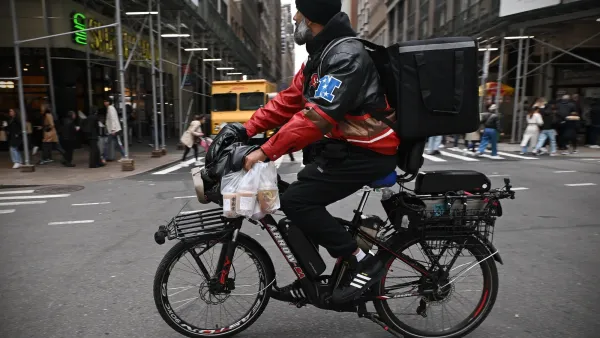
Study: Delivery Workers Are the Safest Cyclists on NYC Roads
A new study shows that delivery workers are more likely to stop at red lights and obey traffic rules than recreational or commuter riders.

California Cuts Funding for E-bike Rebates
The state cancelled an upcoming round of applications for the wildly popular e-bike incentive program that provided up to $2,000 toward the cost of an electric bike.

California Law Delays Bike Parking Requirements
A state law that delays new building code updates after the destructive Eaton and Palisades fires means bike advocates won’t see meaningful changes to bike parking rules for at least two years.

Planetizen Federal Action Tracker
A weekly monitor of how Trump’s orders and actions are impacting planners and planning in America.

The state-sanctioned urbicide of Austin
People don’t kill cities. Freeways do.

US to reduce Colorado River water deliveries to Mexico
A new Colorado Treaty amendment reduces Mexico’s Colorado River water allocation by 250,000 acre feet.

5 New England states march closer to 800 megawatt wind energy project
Securing federal approval for the project may be complicated under the Trump administration, which has historically been hostile towards domestic wind power.

Baltimore to break ground on $50 million Transit Priority Project
The project will bring faster bus trips, safer streets and better bike connections to Baltimore.

Airbnb launches $250 million 'last-dollar financing' housing accelerator, makes first investment in Austin
The company will put $6.4 million towards affordable housing development in Texas’ capital.

FREE Course: Walkable City 1: Why Walkability?
After describing his path towards focusing on walkability as the essence of good planning, Jeff Speck marches through his five principal reasons for making more walkable places.
Reinventing Malls: Planning Alchemy—Turning Gray Fields Into Gold
The course focuses on the opportunities and imperatives that shape reinvention of mall sites.

Eagle County Government
Harvard University Graduate School of Design
Nashville Planning Department
The Architects Foundation
University of Cincinnati Online
The Pocatello Development Authority
The Urban Renewal Agency of the City of Pocatello
Journal of the American Planning Association