The legal challenge is the latest filed against similar zoning reform efforts around the country.


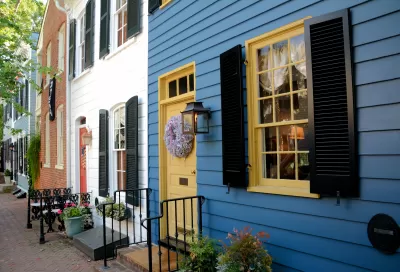
Last November, the city of Alexandria became the second Virginia jurisdiction to eliminate single-family zoning in a bid to increase affordable housing. Now a local civic group created last year to preserve the city’s single-family neighborhoods has filed a lawsuit, reports Teo Armus of the Washington Post.
“The lawsuit, filed in Alexandria Circuit Court this week, argues that the Northern Virginia city violated its charter as well as the Virginia Constitution by loosening zoning rules last year for its more suburban residential areas but failing to adequately study how those changes would the impact the real estate market or the city’s infrastructure,” Armus writes. The city of Alexandria, the city council, and the city’s planning commission as defendants.
The plan was part of a broader package of changes called the “Zoning for Housing” effort and allows for buildings up to four units on lots currently zoned single-family and was approved by the Alexandria City Council unanimously.
According to the Washington Post, the move “mirrors a similar push by at least four states and a growing number of localities — including in nearby Arlington County — to roll back single-family zoning laws, an increasingly popular idea among city planners and urbanist groups who point out those laws were first implemented to keep out people of color.” Lawsuits have been filed around many of those efforts as well; a case in Arlington will go to trial this summer.
Alexandria’s city planners project only around 66 of the city’s 9,000 single-family lots will be converted to multifamily over the next decade, adding about 150 to 178 housing units. But opponents say the studies conducted do not show how the policy change would result in affordable housing or increased resident diversity or prevent developers from replacing older, smaller homes with luxury four-unit buildings. “The lawsuit also charges that no studies were conducted to examine how increased density might affect traffic, schools, first responders or sewer pipes — in violation of the Alexandria city charter and city’s comprehensive plan,” Amos reports.
Read the full story: Alexandria residents sue city to preserve single-family-only zoning
Alexandria Residents Weigh in on Zoning Reform
The city’s proposed ‘Zoning for Housing’ is drawing criticism from multiple sides.

San Diego wants to limit upzoning law to just 16% of transit-adjacent parcels
The city's planning director says some areas are unfit for immediate upzoning due to a lack of resources or hazards such as wildfire risk.
What Actually Got Built Under Eric Adams’ ‘Pro-Housing’ Administration
The outgoing mayor claims credit for hundreds of thousands of new homes. The truth is more complicated.

Planetizen Federal Action Tracker
A weekly monitor of how Trump’s orders and actions are impacting planners and planning in America.

California plans to bury El Niño’s downpour
If the state plays its cards right, it may be able to store a billion acre-feet of El Niño’s water in aquifers.

Desperate measures: Advocates weigh draining Lake Powell to fill Colorado River
Draining the reservoir could reduce evaporation losses by a couple hundred thousand acre-feet.

Mamdani’s pied-à-terre tax survives legal challenge
A panel of judges found that the plaintiffs failed to demonstrate injury as a result of New York City's implementation of the tax.

Eastern Nebraska is running out of electricity
Data centers and electrification are straining eastern Nebraska’s grid, throttling economic development.

Seattle passes record-breaking transit services expansion
Proposition 1 will double the city’s transit tax to add 95,000 more bus trips and preserve 180,000 bus trips annually.

FREE Course: Walkable City 1: Why Walkability?
After describing his path towards focusing on walkability as the essence of good planning, Jeff Speck marches through his five principal reasons for making more walkable places.
Reinventing Malls: Planning Alchemy—Turning Gray Fields Into Gold
The course focuses on the opportunities and imperatives that shape reinvention of mall sites.

City of Rosemead
Rutgers University, Edward J. Bloustein School of Planning and Public Policy
One Hundred Miles
University of Michigan School for Environment and Sustainability (SEAS)
Hunter College, City University of New York (CUNY)
The Architects Foundation
City of Cambridge
Montrose County
The Pocatello Development Authority