Already a challenge for many American parents, finding child care within reach of transit can be nearly impossible.



In an op-ed in Next City, Jason Prokop and Anne Hedgepeth draw attention to the rarely discussed but crucial intersection of child care and public transit.
The authors explain, “America’s cities depend on both child care and public transportation to be livable places. Unfortunately, little attention is paid to how these systems intersect.” For many American parents, finding transit-accessible child care can be nearly impossible.
The authors cite a Nebraska program that aims to bridge this gap and help policymakers understand the link. The data dashboard, which explores public transit and childcare options in metropolitan Nebraska, reveals that “In Lincoln and Greater Omaha, only about 45% of all licensed child care providers serving children under age 6 are located within a 10-minute walk of the nearest public transit stop”—a time frame that can be “insurmountable” for parents of small children.
“The Child Care and Public Transit Dashboard was designed to ensure decision-makers can build systems that better serve their communities, which is good for children, families and our economies.”
FULL STORY: Finding Child Care Is Hard. Finding Transit-Accessible Child Care Can Be Near-Impossible

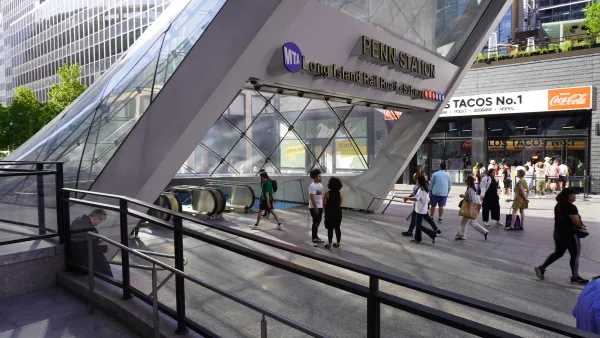
Which US cities have the most housing near transit?
Concentrating housing near frequent, reliable transit offers advantages to both residents and transit agencies, who can serve more riders more efficiently.

Culdesac Tempe Defies Expectations
Despite initial skepticism about its true potential for sustainable urbanism, the built-from-scratch “car-free neighborhood” is widely popular with its residents.
Study: Automobile Dependency Reduces Life Satisfaction
Automobile dependency has negative implications for wellbeing. This academic study finds that relying on a car for more than 50 percent of out-of-home travel is associated with significant reductions in life satisfaction.

The state-sanctioned urbicide of Austin
People don’t kill cities. Freeways do.

US to reduce Colorado River water deliveries to Mexico
A new Colorado Treaty amendment reduces Mexico’s Colorado River water allocation by 250,000 acre feet.

New Jersey’s second-largest city bans standalone data centers
Jersey City will continue to allow co-location facilities, such as those meant for research institutions that store their own data.

Amtrak not solely to blame for New Jersey commuter rail's unreliability, report finds
A new study from the Garden State Initiative found that NJ Transit’s budget grew 20% across a 4 year period, but reliability declined significantly over the same period.

EPA erases limits on planet-warming pollution from power plants
Under Monday’s plan, power plants would still have some limits on how much mercury, arsenic and other contaminants they can emit.

Phoenix announces new on-demand transit service, more frequent RAPID buses
Both new services will launch in October, and are part of Phoenix's Project Effective Access Solutions for Easing Congestion.

FREE Course: Walkable City 1: Why Walkability?
After describing his path towards focusing on walkability as the essence of good planning, Jeff Speck marches through his five principal reasons for making more walkable places.
Reinventing Malls: Planning Alchemy—Turning Gray Fields Into Gold
The course focuses on the opportunities and imperatives that shape reinvention of mall sites.

Eagle County Government
Harvard University Graduate School of Design
Nashville Planning Department
The Architects Foundation
University of Cincinnati Online
The Pocatello Development Authority
The Urban Renewal Agency of the City of Pocatello
Journal of the American Planning Association