The city made a subtle, one-word change that frees up developers to build parking based on actual need and eliminates costly unnecessary parking.


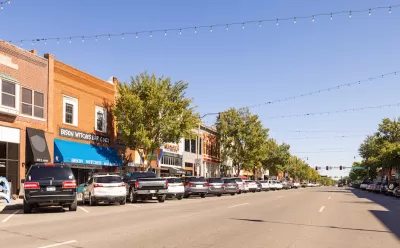
A one-word change unanimously approved by the city council in Norman, Oklahoma could have a major impact on excess parking and construction costs in the city, writes Seairra Sheppard in Next City.
“Basically, all we did in the ordinance was change the word ‘required’ to ‘recommended,’” explained Councilman Matt Peacock.
According to Peacock, “Oklahoma is the only state in the nation that requires its cities to be funded by sales tax alone.” Making the connection to parking, Peacock added, “So when there are massive empty parking lots that are separating buildings by acres, all I see is a lost sales tax base.”
After the change, “Because the parking laws are now recommended instead of required, developers hold a bigger responsibility of tuning in to city needs and proposing an appropriate amount of parking for their business,” Sheppard writes. As Peacock notes, “Parking should be a function of the market, not a function of the building code.”
Read the full story: This City Removed Its Parking Mandates By Changing One Word

Illinois ‘People Over Parking Act’ Bans Parking Requirements Near Transit
The new law could unlock denser, more affordable housing development near train and bus lines.

Denver Could Eliminate Parking Requirements
The city could remove parking mandates citywide to reduce the cost of housing construction and ease permitting for new projects.

Colorado Bill Would End Minimum Parking Requirements
Supporters of the bill say eliminating parking mandates would make housing more affordable and reduce carbon emissions.

Planetizen Federal Action Tracker
A weekly monitor of how Trump’s orders and actions are impacting planners and planning in America.

California plans to bury El Niño’s downpour
If the state plays its cards right, it may be able to store a billion acre-feet of El Niño’s water in aquifers.

Desperate measures: Advocates weigh draining Lake Powell to fill Colorado River
Draining the reservoir could reduce evaporation losses by a couple hundred thousand acre-feet.

Los Angeles just elected an urban planner as its mayor
Transportation analysts are optimistic that Raman will be more aggressive in addressing transit issues than Bass.

Mamdani’s pied-à-terre tax survives legal challenge
A panel of judges found that the plaintiffs failed to demonstrate injury as a result of New York City's implementation of the tax.

Eastern Nebraska is running out of electricity
Data centers and electrification are straining eastern Nebraska’s grid, throttling economic development.

FREE Course: Walkable City 1: Why Walkability?
After describing his path towards focusing on walkability as the essence of good planning, Jeff Speck marches through his five principal reasons for making more walkable places.
Reinventing Malls: Planning Alchemy—Turning Gray Fields Into Gold
The course focuses on the opportunities and imperatives that shape reinvention of mall sites.

City of Rosemead
Rutgers University, Edward J. Bloustein School of Planning and Public Policy
One Hundred Miles
University of Michigan School for Environment and Sustainability (SEAS)
Hunter College, City University of New York (CUNY)
The Architects Foundation
City of Cambridge
Montrose County
The Pocatello Development Authority