The city wants to streamline the process and lower construction costs for accessory dwelling units in order to boost the city’s housing supply without dramatically altering neighborhoods.



Property owners in Raleigh, North Carolina can now purchase pre-approved plans for accessory dwelling units (ADUs) as part of an effort by the city to spur ADU construction and increase the housing supply through gentle density boosts. Bradley George describes the program for WUNC.
The plans, which cost between $400 and $1,400, can save homeowners the time and money involved in developing their own plans, speeding up the process of getting an ADU permitted and built. According to Raleigh director of planning and development Pat Young, “You still have to go through a site assessment to make sure you're meeting all the setbacks and other requirements on site, but the building code issues have been pre-reviewed and pre-approved, essentially.”
Other cities, including Stockton and Los Angeles, are using similar programs to streamline ADU construction and bring down the costs of construction. Raleigh relaxed restrictions on ADUs in 2020, paving the way for ‘gentle density’ increases in its residential neighborhoods.
FULL STORY: Raleigh hopes 'ADU Gallery' will spur affordable housing construction

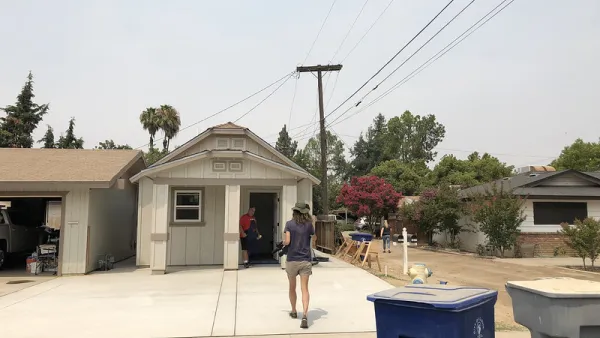
Pre-Approved ADUs Now Available in Sacramento
The city of Sacramento is making it easier to develop accessory dwelling units.

ADUs account for nearly 28% of Bay Area housing permits
In Hillsborough, 56 of 58 homes permitted in 2025 were ADUs.
Report: Massachusetts zoning reform not enough to stimulate ADU production
Massachusetts cities issued over 1,200 applications for ADUs in the last year, short of the Healey administration's goal of 1,600 to 2,000 units per year.

Planetizen Federal Action Tracker
A weekly monitor of how Trump’s orders and actions are impacting planners and planning in America.

The state-sanctioned urbicide of Austin
People don’t kill cities. Freeways do.

US to reduce Colorado River water deliveries to Mexico
A new Colorado Treaty amendment reduces Mexico’s Colorado River water allocation by 250,000 acre feet.

5 New England states march closer to 800 megawatt wind energy project
Securing federal approval for the project may be complicated under the Trump administration, which has historically been hostile towards domestic wind power.

Baltimore to break ground on $50 million Transit Priority Project
The project will bring faster bus trips, safer streets and better bike connections to Baltimore.

Airbnb launches $250 million 'last-dollar financing' housing accelerator, makes first investment in Austin
The company will put $6.4 million towards affordable housing development in Texas’ capital.

FREE Course: Walkable City 1: Why Walkability?
After describing his path towards focusing on walkability as the essence of good planning, Jeff Speck marches through his five principal reasons for making more walkable places.
Reinventing Malls: Planning Alchemy—Turning Gray Fields Into Gold
The course focuses on the opportunities and imperatives that shape reinvention of mall sites.

Eagle County Government
Harvard University Graduate School of Design
Nashville Planning Department
The Architects Foundation
University of Cincinnati Online
The Pocatello Development Authority
The Urban Renewal Agency of the City of Pocatello
Journal of the American Planning Association