When complete, the newly named DFW Discovery Trail will incorporate 50 miles of existing trails into a regional ‘super highway.’


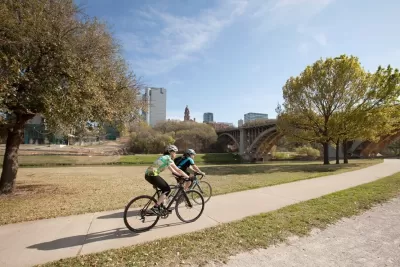
Dallas residents have voted on the name of a new, 66-mile long biking and walking trail that will connect Dallas and the surrounding communities of Arlington, Irving and Grand Prairie. According to local officials, the DFW Discovery Trail will “promote healthy living, reduce traffic congestion and draw tourism for events like races,” writes Sarah Bahari in the Dallas Morning News.
To date, around 50 miles of the trail are open to the public. “Once complete, DFW Discovery Trail will connect existing smaller trails, including the Trinity Skyline Trail in Dallas, Fort Worth Trinity Trails, Campion Trail in Irving and River Legacy Trail in Arlington.”
The North Central Texas Council of Governments (NCTCOG) website describes the agreement to build the trail, stating, “The trail was highlighted as a resource and asset to their communities from an economic development perspective and tourism aspect, as well as the benefits to health and reduction of congestion that alternative transportation routes can offer.”
Read the full story: Long-planned D-FW ‘super highway’ trail finally gets a name

Trump has Slashed Over $750 Million From Bike and Walking Trail Projects
The Trump administration is pulling hundreds of millions allocated under the 2022 Inflation Reduction Act.
Repositioning Bike and Walking Trails as Essential Infrastructure
Cities and states can access federal transportation funding by including trails in long-range transportation plans.
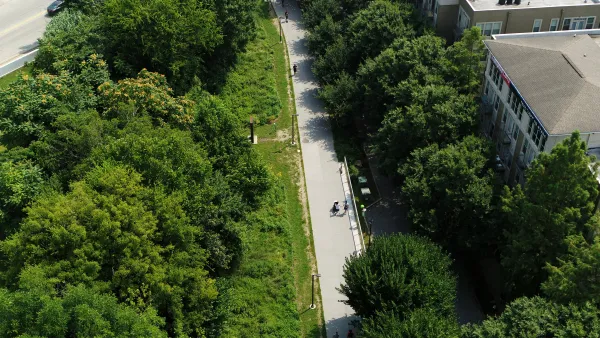
Trees Beautify Segment of Atlanta’s BeltLine
A local nonprofit planted 500 trees along a previously unimpressive segment of the bike and walking trail, creating an ‘instant forest’ effect.

Planetizen Federal Action Tracker
A weekly monitor of how Trump’s orders and actions are impacting planners and planning in America.

California plans to bury El Niño’s downpour
If the state plays its cards right, it may be able to store a billion acre-feet of El Niño’s water in aquifers.

Desperate measures: Advocates weigh draining Lake Powell to fill Colorado River
Draining the reservoir could reduce evaporation losses by a couple hundred thousand acre-feet.

California city breaks ground on transit connector
The project includes three mobility hubs and a pedestrian bridge.

After public outcry, Massachusetts city releases housing development tracker
Cambridge’s tracker currently shows 250 housing projects in various stages of development.

40 years after approval, Chicago breaks ground on new park
The park honors Jean Baptiste Point du Sable, the city’s first permanent non-native settler.

FREE Course: Walkable City 1: Why Walkability?
After describing his path towards focusing on walkability as the essence of good planning, Jeff Speck marches through his five principal reasons for making more walkable places.
Reinventing Malls: Planning Alchemy—Turning Gray Fields Into Gold
The course focuses on the opportunities and imperatives that shape reinvention of mall sites.

City of Rosemead
Rutgers University, Edward J. Bloustein School of Planning and Public Policy
One Hundred Miles
Hunter College, City University of New York (CUNY)
The Architects Foundation
University of Cincinnati Online
City of Cambridge
Montrose County
The Pocatello Development Authority