Oakland, California, will consider a former Army base as the location for its largest shelter as its population of people experiencing homelessness grows.



“Oakland will look into opening a massive homeless shelter for up to 1,000 people on the former army base,” reports Sarah Ravani for the San Francisco Chronicle.
“The Oakland City Council voted unanimously Tuesday to direct the city to study whether it can house up to 1,000 unsheltered people at a 22-acre site that would become the city’s largest shelter,” adds Ravani.
According to public officials quoted in the article, the city is looking for new resources for an increasing number of people experiencing homelessness—the city had a pre-existing shortage of shelter beds and supportive housing even before the pandemic increased the number of people experiencing homelessness on the city’s streets.
“In the last official count in 2019, the city recorded more than 4,000 homeless people living on the streets and saw the largest increase of any city in the Bay Area,” explains Ravani.
In addition to the political opposition a shelter of this size might expect to encounter on its way to approval, the final project will face several large approval hurdles. The property is deed restricted to prohibit residential use without approval from the California Department of Toxic Substances Control and the city-owned site would also require some environmental remediation.
Read the full story: Oakland could open homeless shelter for 1,000 people on former Army base
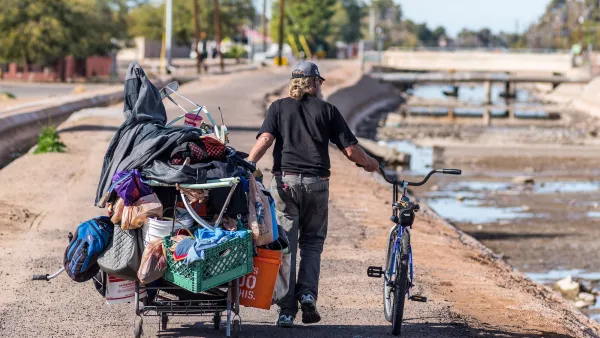
New Phoenix and Oakland Homelessness Plans Prioritize Prevention, Permanent Housing
Phoenix’s unsheltered homeless population grew by 28 percent last year.
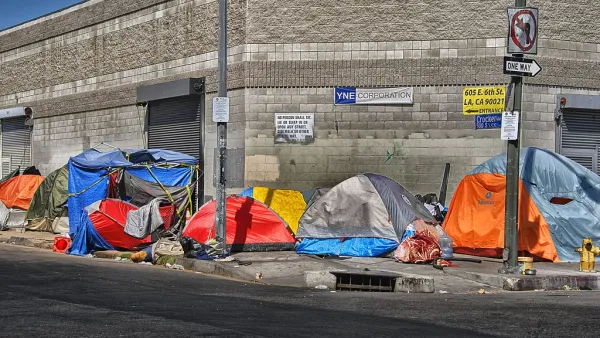
Financial Dire Straights for L.A.’s Skid Row Housing Trust
Terrible news about the financial situation at one of L.A.’s most prominent homeless service providers broke earlier this month.

‘Housing First’ Pilot Launched in New York City
The city has started small with a “Housing First” approach to homelessness—moving 80 people experiencing homelessness into supportive housing in recent months.

Planetizen Federal Action Tracker
A weekly monitor of how Trump’s orders and actions are impacting planners and planning in America.

California plans to bury El Niño’s downpour
If the state plays its cards right, it may be able to store a billion acre-feet of El Niño’s water in aquifers.

Desperate measures: Advocates weigh draining Lake Powell to fill Colorado River
Draining the reservoir could reduce evaporation losses by a couple hundred thousand acre-feet.

Chicago voters approve permanent festival grounds, penalty for vacant property owners
Currently, major summer and fall festivals take over public parks for weeks at a time, drawing criticism from nearby residents

NYC votes to cut outdoor dining red tape, speed up permitting
New York City also voted to allow the Department of Transportation to begin work on urgent projects before notifying elected officials.

California appears to reject Prop. 45
The proposition would have expanded the projects that qualify for a streamlined environmental review, effectively paring down the California Environmental Quality Act.

FREE Course: Walkable City 1: Why Walkability?
After describing his path towards focusing on walkability as the essence of good planning, Jeff Speck marches through his five principal reasons for making more walkable places.
Reinventing Malls: Planning Alchemy—Turning Gray Fields Into Gold
The course focuses on the opportunities and imperatives that shape reinvention of mall sites.

City of Rosemead
Rutgers University, Edward J. Bloustein School of Planning and Public Policy
One Hundred Miles
Hunter College, City University of New York (CUNY)
The Architects Foundation
University of Cincinnati Online
City of Cambridge
Montrose County
The Pocatello Development Authority