Averaging less than 400 square feet per unit, the Sixth and Chicon development is a new take on urban density.



"A six-story 'micro-housing' apartment project by local commercial real estate firm Watershed Development Group has officially broken ground in East Austin, bringing 60 residences to an approximately quarter-acre site at 1812 East Sixth Street," writes James Rambin for Towers.
The tiny units average 355 square feet in size and are located "in what’s most likely East Austin’s single most walkable district and only minutes away from the Plaza Saltillo MetroRail station." To that end, the development only has 19 parking spaces. "To enhance the living experience of its micro-units, the building includes multiple co-working spaces, individual workout rooms on each level, communal kitchens, and outdoor amenities including a rooftop patio. It’s one of many multifamily projects in Austin embracing a philosophy of shared amenities alongside smaller apartments, with increasing demand for these communities in prime locations where walkable lifestyle factors like nearby bars and restaurants take priority over large living spaces."
Rambin calls the development "an inspiring example of dense infill housing — with 60 residences on a quarter-acre site, we’re talking about an approximate density of 240 units per acre, closer to what you’d expect from a significantly taller residential building."
The article quotes Nathan Vargo, founder of Watershed Development Group, the project's builder: "We believe that building housing in submarkets with a rich offering of walkable lifestyle amenities helps to activate the public spaces, support our local merchants, and increases the utilization of public transportation, all of which add to the vibrancy of our great city."
Read the full story: East Austin ‘Micro-Unit’ Apartments Break Ground at Sixth and Chicon


Austin Could Reduce Minimum Lot Sizes
In an effort to increase housing production and bring down housing costs, the city council approved a resolution calling for reduced lot sizes and higher density in single-family neighborhoods.
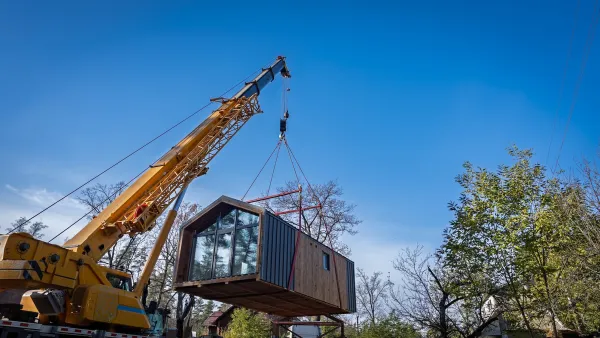
Vermont Catalog of Pre-approved Middle Housing Designs Harkens Back to Sears Catalog Homes
The 802 Homes initiative provides templates for ADUs, duplexes, and other mid-sized homes.
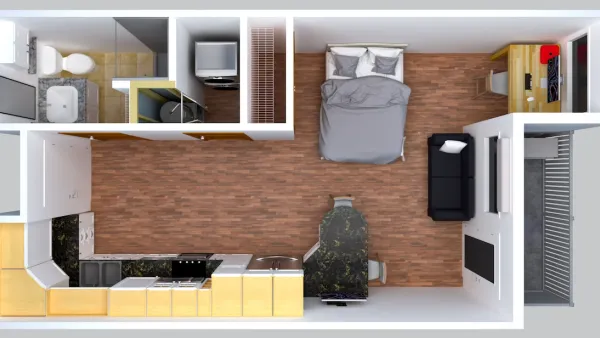
In These Cities, Most New Housing is Under 441 Square Feet
With loosened restrictions on “micro-housing,” tiny units now make up as much as 66% of newly constructed housing.

Planetizen Federal Action Tracker
A weekly monitor of how Trump’s orders and actions are impacting planners and planning in America.

The state-sanctioned urbicide of Austin
People don’t kill cities. Freeways do.

Colorado’s Largest Data Center Could Rise Next to Homes — Without a Public Hearing
The proposed campus would consume 11 times the power of Denver International Airport; as it has across the country, opposition mounts.

Nation's most wind-powered state turns to coal as data centers increase energy demand
For the first time in decades, Iowa has increased its generation of coal power.

NYC cools commuters with city's first rain garden above a bus stop
New York City officials say the plants in the rain garden can absorb 16 gallons of rainwater during heavy storms.

Brightline West’s future may rely on $6 billion federal loan
The company has until Nov. 2 to make a $400 million equity investment into its proposed high-speed rail line.

FREE Course: Walkable City 1: Why Walkability?
After describing his path towards focusing on walkability as the essence of good planning, Jeff Speck marches through his five principal reasons for making more walkable places.
Reinventing Malls: Planning Alchemy—Turning Gray Fields Into Gold
The course focuses on the opportunities and imperatives that shape reinvention of mall sites.

Greater Baltimore Committee
Eagle County Government
Harvard University Graduate School of Design
The Architects Foundation
University of Cincinnati Online
The Pocatello Development Authority
The Urban Renewal Agency of the City of Pocatello
Journal of the American Planning Association