If SF 2171 wins approval in the Iowa State Legislature, solar will have a limited number of options for installation on agricultural land.


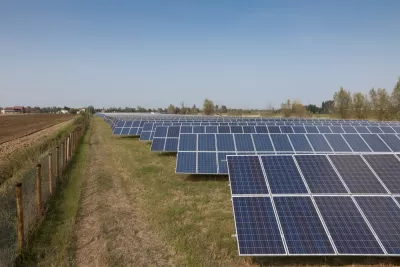
Katie Peikes reports for Iowa Public Radio on a bill moving through the Iowa State Senate that would limit the placement of solar panels on farmland around the state.
"Under the bill, solar panel fields could only be installed on less productive farmland. They also must be at least half a mile from other solar panel fields and not less than 1,250 feet from the nearest neighboring landowner," reports Peikes.
The definition of productive farmland is set to the Iowa State University Extension and Outreach's Corn Suitability 2 Index. "Under the proposal, people can’t install a solar panel field on agricultural land unless the land they want to install it on has a corn suitability rating of 65 or lower. These soils would have less of a corn yield than soils with a rating higher than 65," according to Peikes.
The bill, SF 2127, advanced this week out of the Senate Agricultural Committee, with the debate split on party lines. More on the political debate prompted by the bill and the organizations taking sides on the bill is included in the source article below.
Iowa isn't the only jurisdiction to attempt to limit solar installations in the past year. Delaware County, Indiana briefly implemented a moratorium on solar installations in January of this year, rescinding the moratorium before the end of the month. The state of Louisiana approved two bills in 2021 designed to slow the development of solar power in response to concerns from the state's farmers.
FULL STORY: Iowa lawmakers advance a bill placing restrictions on solar panels built on farmland

Courts order EPA to release billions in climate grants
The grants primarily funded projects aimed at Black, low-income and disadvantaged communities.
Cows at Tennessee's 'Silicon Ranch' graze under solar panels
The project aims to prove that agriculture and solar energy production can work in tandem.
28 States and DC Could Legalize ‘Balcony Solar’
Plug-in solar panels, which are becoming popular across Europe, live in a regulatory gray area in the United States.

The state-sanctioned urbicide of Austin
People don’t kill cities. Freeways do.

US to reduce Colorado River water deliveries to Mexico
A new Colorado Treaty amendment reduces Mexico’s Colorado River water allocation by 250,000 acre feet.

New Jersey’s second-largest city bans standalone data centers
Jersey City will continue to allow co-location facilities, such as those meant for research institutions that store their own data.

Amtrak not solely to blame for New Jersey commuter rail's unreliability, report finds
A new study from the Garden State Initiative found that NJ Transit’s budget grew 20% across a 4 year period, but reliability declined significantly over the same period.

EPA erases limits on planet-warming pollution from power plants
Under Monday’s plan, power plants would still have some limits on how much mercury, arsenic and other contaminants they can emit.

Phoenix announces new on-demand transit service, more frequent RAPID buses
Both new services will launch in October, and are part of Phoenix's Project Effective Access Solutions for Easing Congestion.

FREE Course: Walkable City 1: Why Walkability?
After describing his path towards focusing on walkability as the essence of good planning, Jeff Speck marches through his five principal reasons for making more walkable places.
Reinventing Malls: Planning Alchemy—Turning Gray Fields Into Gold
The course focuses on the opportunities and imperatives that shape reinvention of mall sites.

Eagle County Government
Harvard University Graduate School of Design
Nashville Planning Department
The Architects Foundation
University of Cincinnati Online
The Pocatello Development Authority
The Urban Renewal Agency of the City of Pocatello
Journal of the American Planning Association