The city plans to install temporary housing and facilities as part of its efforts to reduce homelessness and help people move into permanent housing.


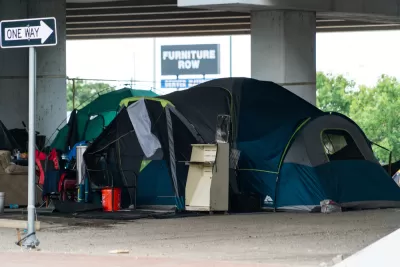
The city of Austin has chosen two potential sites for temporary encampments as "part of implementing the mandates of a May City Council resolution that specifies steps and deadlines for its Housing-Focused Homeless Encampment Assistance Link initiative," such as calling for the City Manager to "identify publicly-owned land or land within the city limits owned by other intergovernmental entities or willing community partners that could accommodate tiny home structures to serve as temporary housing" and present a budget for implementation.
As Cindy Widner writes, "the sites would need to be rezoned prior to the installation of temporary, prefab microshelters, which—along with fencing and round-the-clock security—the city apparently plans to provide." The city-owned locations were chosen based on their proximity to Capital Metro routes, the availability of utilities, and other factors. "According to a memo from Dianna Grey, the city's homeless strategy officer, and Parks and Recreation Department Director Kimberly McNeeley, 'Both properties are owned by the City of Austin, are being held for future creation of affordable housing, and could be used temporarily until that development takes place.'"
FULL STORY: City considers two sites for sanctioned encampments

Austin Creates Homeless Strategy Office
The new office is dedicated to consolidating the city’s efforts to house unhoused residents.
Austin Reallocates Police Funding to Homeless Housing and Services
The city is using the redistributed money to purchase hotels for permanent housing and provide supportive services.
Seattle mayor pledges to build 500 shelter units by June
The Seattle Times editorial board expresses cautious optimism about the mayor's ambitious supportive housing plan.

Planetizen Federal Action Tracker
A weekly monitor of how Trump’s orders and actions are impacting planners and planning in America.

The state-sanctioned urbicide of Austin
People don’t kill cities. Freeways do.

US to reduce Colorado River water deliveries to Mexico
A new Colorado Treaty amendment reduces Mexico’s Colorado River water allocation by 250,000 acre feet.

5 New England states march closer to 800 megawatt wind energy project
Securing federal approval for the project may be complicated under the Trump administration, which has historically been hostile towards domestic wind power.

Baltimore to break ground on $50 million Transit Priority Project
The project will bring faster bus trips, safer streets and better bike connections to Baltimore.

Airbnb launches $250 million 'last-dollar financing' housing accelerator, makes first investment in Austin
The company will put $6.4 million towards affordable housing development in Texas’ capital.

FREE Course: Walkable City 1: Why Walkability?
After describing his path towards focusing on walkability as the essence of good planning, Jeff Speck marches through his five principal reasons for making more walkable places.
Reinventing Malls: Planning Alchemy—Turning Gray Fields Into Gold
The course focuses on the opportunities and imperatives that shape reinvention of mall sites.

Eagle County Government
Harvard University Graduate School of Design
Nashville Planning Department
The Architects Foundation
University of Cincinnati Online
The Pocatello Development Authority
The Urban Renewal Agency of the City of Pocatello
Journal of the American Planning Association