If the combined effects of winter's cold and the pandemic has you bummed, check out this community-building exercise in the frozen North.


Hazel Borys writes:
Where I live in Winnipeg, Manitoba, Canada, we have been under Critical Code Red COVID restrictions since November 12. Within this setting, I was beginning to really miss my friends, a sentiment shared by most everyone. While we would meet up for physically-distanced, masked walks, the lack of our usual sense of community exacerbates the uncertainty sparked by the pandemic. This seems to be a global feeling. On one of our walks on the banks of the Assiniboine River in late November, we discussed ways that we could gather safely, stay connected, have some fun, and give back to our neighbours.
Borys goes on to lay out the process for a pop-up park she built on the river with her friends. And then shows how it implements three out of 22 actions of the Pandemic Toolkit aimed at rebuilding local economies and connections. For example:
4: Enable outdoor learning... via use of parkland.
9: Expedite temporary uses.
10: Increase access to nature ... via pocket parks.
Read the full story: Serpentine Maze: Pop-up parks in a time of pandemic


Reimagined Public Spaces and Programming During the Pandemic
Public spaces have become more important than ever. Here are five case studies of innovative and safely designed programming that engages people of all ages and backgrounds.
Lessons Emerge as Cities Cede Public Space to Contain the Pandemic
One of the dominant themes to emerge from the spread of COVID-19 is the conflict between the need to be in nature for health and well-being while avoiding public space as much as possible to prevent the spread.
Why Playgrounds Need to Stay Open
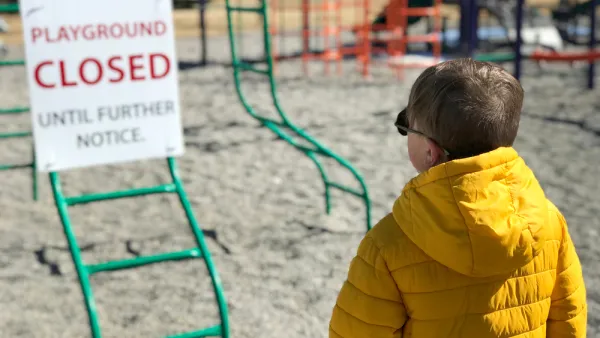
California has reversed its decision to close playgrounds as part of the state's stay-at-home order after some legislators and parents complained and argued that children need outdoor play for their health and well-being.

Planetizen Federal Action Tracker
A weekly monitor of how Trump’s orders and actions are impacting planners and planning in America.

California plans to bury El Niño’s downpour
If the state plays its cards right, it may be able to store a billion acre-feet of El Niño’s water in aquifers.

Chicago breaks ground on $3 billion megadevelopment
The new neighborhood, titled Foundry Park, will one day host 3,700 residences.

California High-Speed Rail Authority CEO resigns after $600,000 scandal
Under Ian Choudri, the authority used taxpayer dollars to fund first class flights and trips to nightclubs.

Want to study the Missouri River? Soon, you may need unanimous approval from 10 states
Legislation would require 10 governors’ permission to study or build projects moving water outside the basin.

Desperate measures: Advocates weigh draining Lake Powell to fill Colorado River
Draining the reservoir could reduce evaporation losses by a couple hundred thousand acre-feet.

FREE Course: Walkable City 1: Why Walkability?
After describing his path towards focusing on walkability as the essence of good planning, Jeff Speck marches through his five principal reasons for making more walkable places.
Reinventing Malls: Planning Alchemy—Turning Gray Fields Into Gold
The course focuses on the opportunities and imperatives that shape reinvention of mall sites.

City of Rosemead
Rutgers University, Edward J. Bloustein School of Planning and Public Policy
One Hundred Miles
Hunter College, City University of New York (CUNY)
The Architects Foundation
University of Cincinnati Online
City of Cambridge
Montrose County
The Pocatello Development Authority