Remember that $450 million plan to renovate The Alamo in time for the 300th anniversary of the battle? It's in trouble.


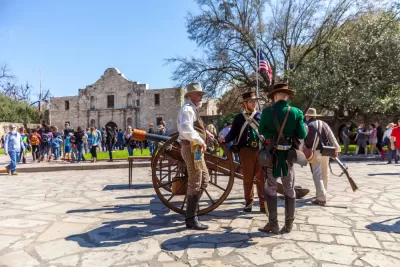
A decision by the Texas Historical Commission will block a key piece of the $450 million master plan to renovate The Alamo Plaza site in San Antonio.
"The Texas Historical Commission's vote to deny a request by city and state leaders to move the Alamo Cenotaph has thrown a $450 million plan to redevelop the site and its surrounding area into uncertainty," reports W. Scott Bailey.
"The plan was to move the Cenotaph south of the Alamo toward Commerce Street as part of a broader redesign of the area to include developing a new Alamo museum and visitors’ center," adds Bailey.
The Cenotaph was erected in 1936 to honor those who died during the Battle of the Alamo in 1836.
The article includes numerous soundbites from officials and elected officials representing the sity, the state, and The Alamo. The Associated Press also picked up the news of the Texas Historical Commission's vote.
For more background on the $450 million master plan for the revitalization of The Alamo, see previous earlier articles shared on Planetizen.
- A First Look at the Alamo's $450 Million Master Plan (April 2017)
- Alamo Plaza Revitalization Takes Small, Controversial Step Forward (September 2018)
- Final Renovation Plan for the Alamo Plaza Approved (October 2018)
Read the full story: Vote on Alamo Cenotaph puts $450M redevelopment plan in limbo

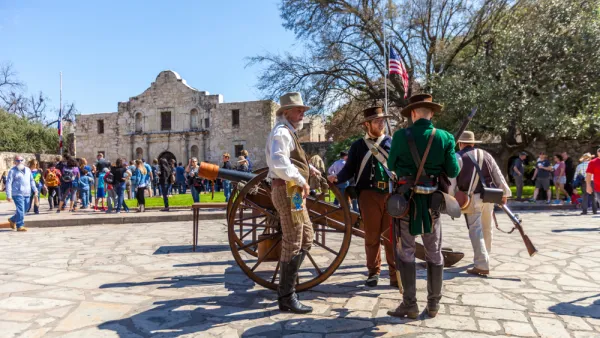
Final Renovation Plan for the Alamo Plaza Approved
The San Antonio City Council culminated years of planning and design this week by approving a plan to overhaul the Alamo Plaza.
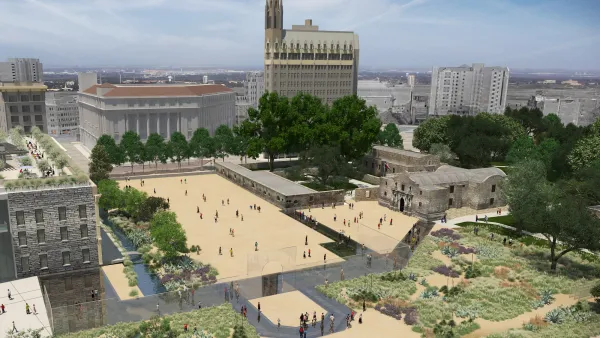
Alamo Plaza Revitalization Takes Small, Controversial Step Forward
Revitalization plans for the Alamo Plaza are moving forward, controversially, in San Antonio. The hope is to have investments complete by the 300th anniversary of the Alamo in 2024.
A First Look at the Alamo's $450 Million Master Plan
The Alamo's 300th birthday is coming up in 2024, and a $450 million project to reimagine the Alamo Plaza aims to make a visit to the historic site a more memorable experience.

Planetizen Federal Action Tracker
A weekly monitor of how Trump’s orders and actions are impacting planners and planning in America.

Amtrak, CN end decades-long dispute with eight-year agreement
The new operating agreement establishes an updated framework for the companies to work together, including processes to resolve disputes.

Judges permit Denver to divert 77,000 acre feet from the Colorado River for reservoir expansion
Overuse and climate change have caused the Colorado River’s water levels to plummet.

Idaho may see an 18% drop in federal surface transit funding — the largest estimated cut in the US
Transit systems in rural communities are much more reliant on federal funding to provide their services.

How ‘post-disaster gentrification’ alters neighborhoods after natural calamities
After hurricanes, fires or other calamities, the original residents of a community are often replaced by younger, wealthier residents.

Maryland local governments examine if they should have more power to raise property taxes
Maryland’s housing market is out of reach for the majority of moderate-income residents.

FREE Course: Walkable City 1: Why Walkability?
After describing his path towards focusing on walkability as the essence of good planning, Jeff Speck marches through his five principal reasons for making more walkable places.
Reinventing Malls: Planning Alchemy—Turning Gray Fields Into Gold
The course focuses on the opportunities and imperatives that shape reinvention of mall sites.

Harvard University Graduate School of Design
KFH Group Inc.
Greater Baltimore Committee
The Architects Foundation
University of Cincinnati Online
The Pocatello Development Authority
The Urban Renewal Agency of the City of Pocatello