The rallying cry to cancel rent has been heard since the early days of the pandemic, but it takes on new urgency now as the economic effects of the pandemic linger past the expiration date of eviction moratoriums.


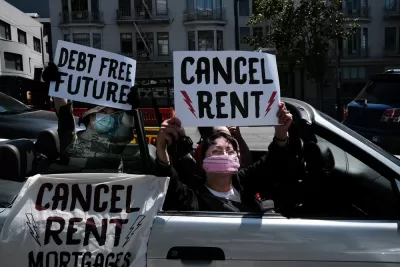
Lupe Arreola, executive director of Tenants Together in California, and Amee Chew, a Mellon-ACLS public fellow, write an opinion piece for the Guardian that makes the case for aggressive action to mitigate the effects of the pandemic depression on renters in cities around the United States.
First, the duo lay out the current situation facing U.S. renters as eviction moratoriums expire at every level of government, with back rent owed.
As many as 40 million people nationwide face eviction due to inability to pay rent. In comparison, the 2008 foreclosure crisis saw the loss of 10m homes. Now, millions – seniors, people with disabilities, parents and children – are at risk of homelessness. Eviction preys disproportionately, in many places overwhelmingly, on Black women and people of color, deepening savage racial inequities.
The action recommended by Arreola and Chew is to cancel rent and mortgage payments. It's the "most effective solution to the mounting debt and mass displacement threatening working-class communities, communities of color and low-income households during and after the Covid-19 pandemic," according to this opinion.
Moreover, the duo recommend an action commensurate with the scope of the problem, and to provide universal support to ensure that no one falls through the cracks:
We must protect renters universally by canceling rent for all renters, regardless of income, employment or immigration status. This eliminates applications, proofs of eligibility and waits for relief. By protecting all renters, we swiftly aid the most marginalized among them. Universal rent cancellation promotes race, gender and economic justice because of who renters are: mostly working-class or low-income, and disproportionately of color. In contrast, requiring renters to apply for assistance means that huge swathes of people fall through the cracks.
Still, the article acknowledges that the rent relief package proposed here won't solve the fundamental issues driving the crisis, like real estate speculation and a development market tilted toward private companies and the high-end market. "To truly address the housing crisis, we must limit rents and massively fund social housing that is permanently affordable," according to the opinion. Also recommend: stopping the consolidation of distressed properties by private equity companies and large, institutional actors.
Existing models and ongoing legislative efforts to inform future actions are also included in the opinion piece.
Read the full story: The US is facing an eviction tsunami. We must cancel rent before it's too late

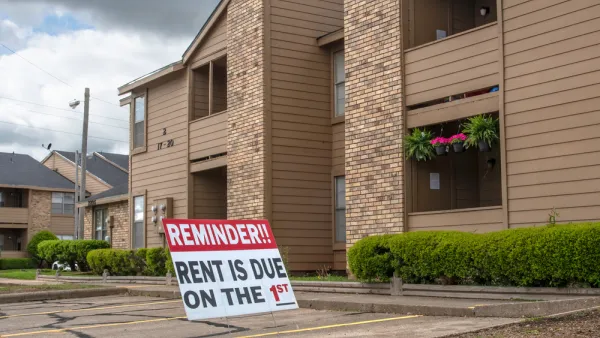
CDC's Eviction Moratorium Extended
The CDC's eviction moratorium will stay in place until at least June 30, 2021.
Landlords, Investors Lining Up to Evict Non-Paying Tenants
Rental housing is booming business, and some landlords and their investors see additional dollar signs in the potential to evict tenants protected by eviction moratoria up until this point in the pandemic.
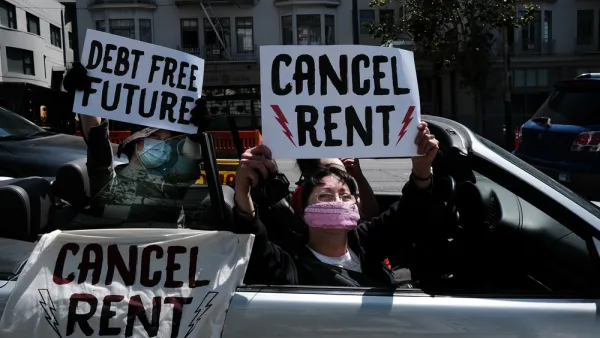
U.S. Rent Debt Estimated at More Than $21 Billion
The National Equity Atlas has been tracking national rent debt, which takes on new meaning since the federal eviction moratorium expired at the end of July.

Planetizen Federal Action Tracker
A weekly monitor of how Trump’s orders and actions are impacting planners and planning in America.

The state-sanctioned urbicide of Austin
People don’t kill cities. Freeways do.

US to reduce Colorado River water deliveries to Mexico
A new Colorado Treaty amendment reduces Mexico’s Colorado River water allocation by 250,000 acre feet.

Nation's most wind-powered state turns to coal as data centers increase energy demand
For the first time in decades, Iowa has increased its generation of coal power.

NYC cools commuters with city's first rain garden above a bus stop
New York City officials say the plants in the rain garden can absorb 16 gallons of rainwater during heavy storms.

Brightline West’s future may rely on $6 billion federal loan
The company has until Nov. 2 to make a $400 million equity investment into its proposed high-speed rail line.

FREE Course: Walkable City 1: Why Walkability?
After describing his path towards focusing on walkability as the essence of good planning, Jeff Speck marches through his five principal reasons for making more walkable places.
Reinventing Malls: Planning Alchemy—Turning Gray Fields Into Gold
The course focuses on the opportunities and imperatives that shape reinvention of mall sites.

Eagle County Government
Harvard University Graduate School of Design
Nashville Planning Department
The Architects Foundation
University of Cincinnati Online
The Pocatello Development Authority
The Urban Renewal Agency of the City of Pocatello
Journal of the American Planning Association