A step toward an overhaul of the way speed is managed on city streets around the country.


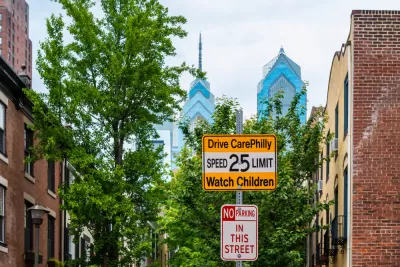
"The National Association of City Transportation Officials (NACTO) [in July] released a guide urging local leaders to rethink how they set speed limits on city streets in a bid to prevent pedestrian deaths," reports Chris Teale.
The "City Limits" guide recommends that cities "[set] default speed limits on many streets at once, designate slow zones in what they deem "sensitive areas" and set speed limits on major corridors by using studies that take into account density and activity level."
NACTO describes this guidance as furthering goals set forth by the National Transportation Safety Board (NTSB) in 2017 to completely overhaul how speed is managed on U.S. streets, including the way that speed limits are set.
Teale cites NACTO Program Manager Jenny O'Connell in stating that NACTO's new guidance would recommend the demise of the 85th percentile rule, "which involves measuring 100 drivers traveling without traffic and setting the speed limit based on the 15th-fastest driver." The 85th percentile rule has been used by some jurisdictions to justify higher speed limits for the sake of enforcement.
Read the full story: NACTO urges shift from 'outdated' speed-limit planning

The Weird Way US Cities Set Speed Limits — and Why it’s Changing
The ‘85% rule’ guides speed limits based on how fast most drivers travel, sometimes prompting cities to raise speed limits.

The 85th Percentile Rule, Explained
A video explainer of the notorious traffic law that explains why some cities have to raise speed limits to enforce traffic safety.

Raising Speed Limits in the Name of Traffic Safety
Business Insider offers a platform for an argument favored by the National Motorists Association and a particularly vocal Michigan state police officer: that speed limits are too slow to be safe.

Planetizen Federal Action Tracker
A weekly monitor of how Trump’s orders and actions are impacting planners and planning in America.

Eastern Nebraska is running out of electricity
Data centers and electrification are straining eastern Nebraska’s grid, throttling economic development.

Washington state to charge fee to drivers with fuel-efficient cars
Revenue from the fee will go towards supporting the state’s highways.

Instead of building new housing, LA developers are turning mansions into mega-mansions
In the richest areas, the number of houses valued at $30 million with demolition permits has skyrocketed since 2018.

Illinois considers spending $1 billion in taxpayer money on data center
A quantum computing campus and data center are currently under construction in Chicago.

As development costs rise, Boston moves to lessen affordable housing requirements
The Boston Zoning Commission and the City Council still need to approve Boston Mayor Michelle Wu’s proposed changes

FREE Course: Walkable City 1: Why Walkability?
After describing his path towards focusing on walkability as the essence of good planning, Jeff Speck marches through his five principal reasons for making more walkable places.
Reinventing Malls: Planning Alchemy—Turning Gray Fields Into Gold
The course focuses on the opportunities and imperatives that shape reinvention of mall sites.

City of Charlotte
City of Rosemead
Rutgers University, Edward J. Bloustein School of Planning and Public Policy
University of Michigan School for Environment and Sustainability (SEAS)
Hunter College, City University of New York (CUNY)
The Architects Foundation
City of Cambridge
The Pocatello Development Authority
The Urban Renewal Agency of the City of Pocatello