In this interview with Emily Badger of the New York Times, Natalie Moore of WBEZ Chicago, and Amanda Kolson Hurley of Bloomberg Businessweek, Slate's Henry Grabar asks about the future viability of America's cities and suburbs in a time of COVID-19


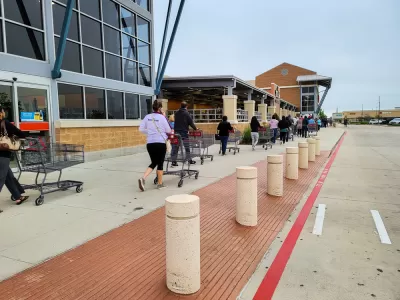
"In the early days of the pandemic, there were a number of articles speculating about: Is COVID a sort of urban disease? Is this an urban phenomenon? Is it because of density? Is it because of the subway? And from the beginning, that struck me as the wrong question to ask. In suburbs, whatever level of density and whatever that suburb looks like, people are going to houses of worship, kids are going to school, people are going to the gym, they’re going to Walmart or whatever, they’re going to the grocery store. And actually the more that we’ve learned about how the virus spreads and what the riskiest situations are for becoming infected, the more that kind of city-suburb distinction really breaks down."
Read the full story: Will COVID Push People Out of Cities for Good?

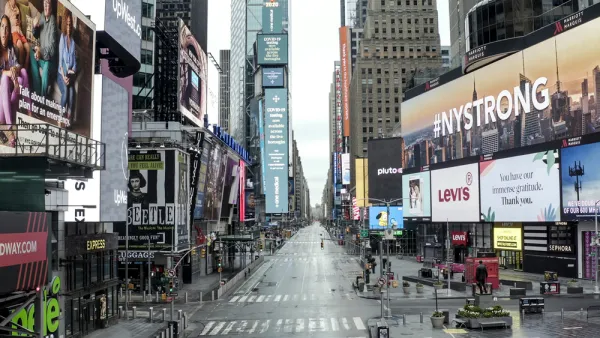
Biden Signs Legislation Ending Covid 19 National Emergency
The Covid 19 national emergency enacted by then-President Donald Trump in March 2020 was officially ended on Monday by President Joe Biden.
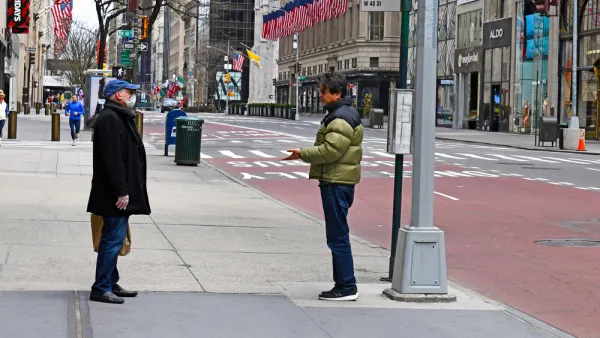
Friday Eye Candy: Covid-19, Then and Now
The New York Times compared images from readers portraying similar scenes in 2020 and 2022.

D.C., San Francisco Lead Pandemic Work From Home Trend
Remote work increased threefold during the pandemic, but the numbers vary significantly from city to city and region to region. Almost half of D.C.-area employees, for example, worked from home in 2021, according to American Community Survey data.

Planetizen Federal Action Tracker
A weekly monitor of how Trump’s orders and actions are impacting planners and planning in America.

California plans to bury El Niño’s downpour
If the state plays its cards right, it may be able to store a billion acre-feet of El Niño’s water in aquifers.

Desperate measures: Advocates weigh draining Lake Powell to fill Colorado River
Draining the reservoir could reduce evaporation losses by a couple hundred thousand acre-feet.

How a Chicago-sized wind farm beat the odds and powered on
The project spanned five presidential administrations and a standoff with a U.S. military base.

MTA gives itself 30 days to transform pit into basketball court
The site has been under construction since 2022; the city originally estimated it would finish the court in 2024.

Non-stop party: Chicago voters weigh permanent festival grounds
A stable place for bleachers, stages and drainage may streamline the setup and teardown of large events.

FREE Course: Walkable City 1: Why Walkability?
After describing his path towards focusing on walkability as the essence of good planning, Jeff Speck marches through his five principal reasons for making more walkable places.
Reinventing Malls: Planning Alchemy—Turning Gray Fields Into Gold
The course focuses on the opportunities and imperatives that shape reinvention of mall sites.

City of Rosemead
Rutgers University, Edward J. Bloustein School of Planning and Public Policy
One Hundred Miles
Hunter College, City University of New York (CUNY)
The Architects Foundation
University of Cincinnati Online
City of Cambridge
Montrose County
The Pocatello Development Authority