A knee-jerk history of coronavirus in New York City is being revised.


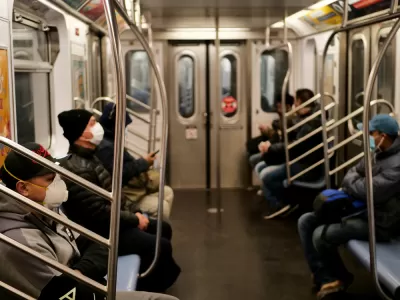
Janette Sadik-Khan, former commissioner of the New York City Department of Transportation and co-author of Streetfight: Handbook for an Urban Revolution, joins with Seth Solomonow, the other co-author of Streetfight, to write an article for The Atlantic that reclaims the high ground of epidemiological evidence in the spread of coronavirus in New York City.
To sum: there was never as much evidence about the spread of the novel coronavirus on public transit in New York as some reports and media narratives claimed.
The headline of a recent report by an MIT economics professor read like the title of a 1950s horror film: “The Subways Seeded the Massive Coronavirus Epidemic in New York City.” The report concluded that New York’s subway system was “a major disseminator—if not the principal transmission vehicle” in the city’s COVID-19 outbreak.
Numerous articles followed and the narrative gained steam. "Some elected officials urged Governor Andrew Cuomo to shut down New York’s transit system," according to the article.
Underlying all that fear, however, "is an assumption of danger that, so far, research has not borne out." For instance, "[a] recent study in Paris found that none of 150 identified coronavirus infection clusters between early May and early June originated on the city’s transit systems. A similar study in Austria found that not one of 355 case clusters in April and May was traceable to riding transit."
For more insight into understanding the risk of contagion while riding public transit, see a recent Planetizen article written by Todd Litman.
FULL STORY: Fear of Public Transit Got Ahead of the Evidence

Falling Transit Ridership 'Disastrous' for Greenhouse Gas Reductions
With ridership at record lows and agencies struggling to stay afloat, public transit around the world will need robust investment to recover after the pandemic.
Nine Months Later: How the Pandemic Is Changing Communities
Planetizen shares the latest in a series of compendia tackling the effects of the pandemic, now and in the future, for cities and communities.
Lessons from Pandemics: Transportation Risks and Safety Strategies
Many people assume that infectious disease risks make public transport dangerous and automobile travel safe, but this is generally untrue. Other factors have more effect on pandemic risk.

Planetizen Federal Action Tracker
A weekly monitor of how Trump’s orders and actions are impacting planners and planning in America.

The state-sanctioned urbicide of Austin
People don’t kill cities. Freeways do.

US to reduce Colorado River water deliveries to Mexico
A new Colorado Treaty amendment reduces Mexico’s Colorado River water allocation by 250,000 acre feet.

5 New England states march closer to 800 megawatt wind energy project
Securing federal approval for the project may be complicated under the Trump administration, which has historically been hostile towards domestic wind power.

Baltimore to break ground on $50 million Transit Priority Project
The project will bring faster bus trips, safer streets and better bike connections to Baltimore.

Airbnb launches $250 million 'last-dollar financing' housing accelerator, makes first investment in Austin
The company will put $6.4 million towards affordable housing development in Texas’ capital.

FREE Course: Walkable City 1: Why Walkability?
After describing his path towards focusing on walkability as the essence of good planning, Jeff Speck marches through his five principal reasons for making more walkable places.
Reinventing Malls: Planning Alchemy—Turning Gray Fields Into Gold
The course focuses on the opportunities and imperatives that shape reinvention of mall sites.

Eagle County Government
Harvard University Graduate School of Design
Nashville Planning Department
The Architects Foundation
University of Cincinnati Online
The Pocatello Development Authority
The Urban Renewal Agency of the City of Pocatello
Journal of the American Planning Association