Two New York Times reporters spent three months in the High Street Camp, a homeless community of 100 people in Oakland, California.


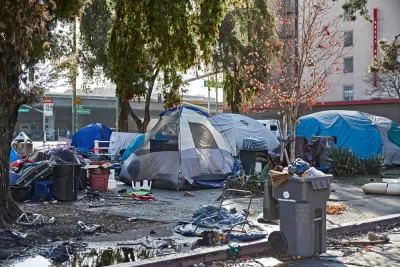
Thomas Fuller and Josh Haner report from the High Street Camp in Oakland, California, a homeless encampment that the reporters also describe as refugee encampment. The camp, home to 100 people, sprawls across in a Home Depot parking lot, 100 people living there.
Drone footage, portrait photography, and video on the ground provide the interactive piece a rare kind of access to this dire place—"the end of the world" as one resident describes it.
Personal disasters, natural disasters, and out-of-reach housing prices have brought the residents of the community here. As noted throughout the piece—all in the nation's wealthyiest state, just across the Bay from glass condominium towers. A United Nations official quoted in the article compares the camp, located so close to such incredible wealth, to similar conditions in Delhi.
Still, according to the article, a sense of community pervades the camp, despite the many risks involved in living there. Still, one of the worst things about living there, according to the reporters' knowledge of the residents, is knowing you could be forced to leave at any moment.
Read the full story: Among the World's Most Dire Places: This California Homeless Camp
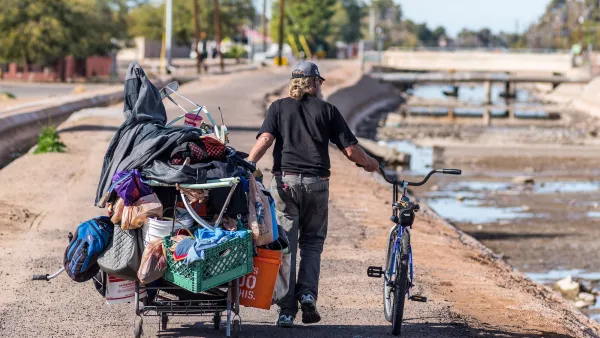
New Phoenix and Oakland Homelessness Plans Prioritize Prevention, Permanent Housing
Phoenix’s unsheltered homeless population grew by 28 percent last year.
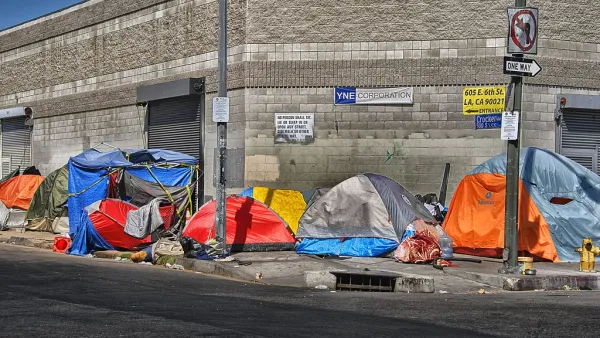
Homelessness Fuels a Backlash in California
The Golden State's ongoing homelessness crisis has residents on edge and is testing the limits of empathy in a state known for its liberal values.
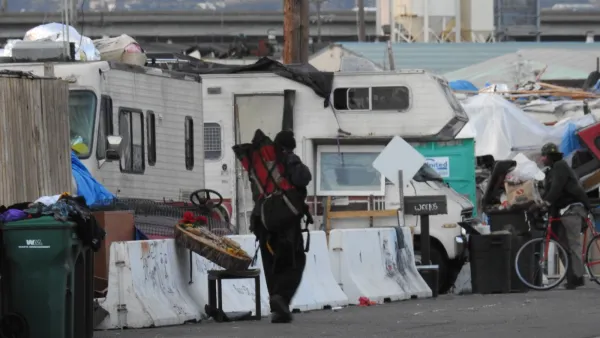
Oakland Mayor, City Council Offer ‘Radically Different’ Plans for Reducing Homelessness
Mayor Barbara Lee wants to reduce encampment sweeps and focus on improving sanitation while city council members want to increase enforcement, particularly against illegally parked RVs.

Planetizen Federal Action Tracker
A weekly monitor of how Trump’s orders and actions are impacting planners and planning in America.

California plans to bury El Niño’s downpour
If the state plays its cards right, it may be able to store a billion acre-feet of El Niño’s water in aquifers.

Desperate measures: Advocates weigh draining Lake Powell to fill Colorado River
Draining the reservoir could reduce evaporation losses by a couple hundred thousand acre-feet.

Mamdani’s pied-à-terre tax survives legal challenge
A panel of judges found that the plaintiffs failed to demonstrate injury as a result of New York City's implementation of the tax.

Eastern Nebraska is running out of electricity
Data centers and electrification are straining eastern Nebraska’s grid, throttling economic development.

Seattle passes record-breaking transit services expansion
Proposition 1 will double the city’s transit tax to add 95,000 more bus trips and preserve 180,000 bus trips annually.

FREE Course: Walkable City 1: Why Walkability?
After describing his path towards focusing on walkability as the essence of good planning, Jeff Speck marches through his five principal reasons for making more walkable places.
Reinventing Malls: Planning Alchemy—Turning Gray Fields Into Gold
The course focuses on the opportunities and imperatives that shape reinvention of mall sites.

City of Rosemead
Rutgers University, Edward J. Bloustein School of Planning and Public Policy
One Hundred Miles
University of Michigan School for Environment and Sustainability (SEAS)
Hunter College, City University of New York (CUNY)
The Architects Foundation
City of Cambridge
Montrose County
The Pocatello Development Authority