The federal government was considering a plan to raise the height of the dam on California's largest reservoir. But the area’s water district recently announced that it will not continue with an environmental study of the project.


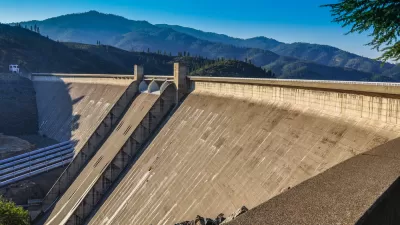
"In a recent turn of events, according to E&E News, the Westlands Water District announced in early October that it is halting its environmental study of raising the height of Shasta Dam [in California]. The study was meant to evaluate the environmental impacts as well as assess whether the project was worth the investment," reports Kalen Goodluck.
Goodluck says that for decades agricultural and municipal water districts have advocated for raising the dam to increase water supplies in the reservoir, Shasta Lake. The Department of the Interior, with support from some members of Congress, had revisited the idea of raising the dam’s height.
Environmentalists have opposed the proposal, and state officials say it would violate state law. "It is also opposed by the Winnemem Wintu Tribe, whose members were forced out during the dam’s construction; they say even more ancestral land would be swallowed up," notes Goodluck.
FULL STORY: Environmental study of Shasta Dam height halted

Why Are the Feds Suddenly in Favor of Raising the Shasta Dam?
Despite state opposition and potential violations of California law, the Trump Administration has revived a project that was deemed impracticable only a few years ago.
The Interior Secretary's Past Lobbying Work Scrutinized
A project to raise the height of the Shasta Dam, dead in the water before the Trump administration, is moving forward now that a former lobbyist for the project is the secretary of the U.S. Department of the Interior.
Massive Wall to Dry Flooded Kingdom
In order to save an ancient kingdom that was flooded by a reservoir in the 1950s, officials in Bulgaria will build a €100 million wall around the submerged monument.

Planetizen Federal Action Tracker
A weekly monitor of how Trump’s orders and actions are impacting planners and planning in America.

The state-sanctioned urbicide of Austin
People don’t kill cities. Freeways do.

US to reduce Colorado River water deliveries to Mexico
A new Colorado Treaty amendment reduces Mexico’s Colorado River water allocation by 250,000 acre feet.

5 New England states march closer to 800 megawatt wind energy project
Securing federal approval for the project may be complicated under the Trump administration, which has historically been hostile towards domestic wind power.

Baltimore to break ground on $50 million Transit Priority Project
The project will bring faster bus trips, safer streets and better bike connections to Baltimore.

Airbnb launches $250 million 'last-dollar financing' housing accelerator, makes first investment in Austin
The company will put $6.4 million towards affordable housing development in Texas’ capital.

FREE Course: Walkable City 1: Why Walkability?
After describing his path towards focusing on walkability as the essence of good planning, Jeff Speck marches through his five principal reasons for making more walkable places.
Reinventing Malls: Planning Alchemy—Turning Gray Fields Into Gold
The course focuses on the opportunities and imperatives that shape reinvention of mall sites.

Eagle County Government
Harvard University Graduate School of Design
Nashville Planning Department
The Architects Foundation
University of Cincinnati Online
The Pocatello Development Authority
The Urban Renewal Agency of the City of Pocatello
Journal of the American Planning Association