Improving the systems and politics of transportation funding could ensure more local money, more efficient land use planning and mobility choices, and more.



The Metropolitan Area Planning Council, the regional planning agency for metropolitan Boston, recently released a report that recommends 14 steps for developing a sustainable and resilient transportation financing system.
According to an article by Elise Harmon promoting the report, the 14 recommendations are proposed as a menu of options: "multiple solutions will likely be needed to address our local, regional, and statewide transportation goals."
"The released goals include recommendations to provide local funding options to cities and towns, encourage smart growth and mode shift, and raise broad-based revenue for transportation improvements."
Among the 14 total, four recommendations focus on providing funding to local needs, four recommendations focus on encouraging mode shift and smart growth, and six general recommendations are designed to increase revenues.
FULL STORY: MAPC Releases Transportation Finance Recommendations

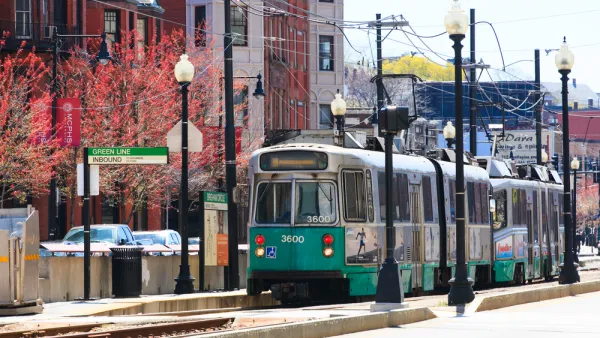
New Transit Oriented Zoning Criteria Proposed for Massachusetts
More details on the state of Massachusetts' game changing "Housing Choice" program are now available.

Local Leaders Press Massachusetts for New Sources of Transportation Funding
Three separate coalitions of local mayors, each from different corners of Eastern Massachusetts, want to the commonwealth to prioritize transportation funding. Some even called for a 15-cent increase to the gas tax.

How, and Where, Land Use Regulations Block Multi-Family Housing in the Boston Region
New analysis explores every city and suburb in the Boston region to reveal the tools of multi-family housing obstruction—sometimes it takes more than zoning to block apartments from getting built.

Planetizen Federal Action Tracker
A weekly monitor of how Trump’s orders and actions are impacting planners and planning in America.

The state-sanctioned urbicide of Austin
People don’t kill cities. Freeways do.

US to reduce Colorado River water deliveries to Mexico
A new Colorado Treaty amendment reduces Mexico’s Colorado River water allocation by 250,000 acre feet.

LA Metro’s ultimatum: no extra buses for LA28 if federal funding isn’t imminently secured
If Metro does not provide additional buses, LA28 organizers will have to find a new way to manage Olympic traffic. LA28’s budget does not include a line item for transit.

Colorado’s Largest Data Center Could Rise Next to Homes — Without a Public Hearing
The proposed campus would consume 11 times the power of Denver International Airport; as it has across the country, opposition mounts.

5 New England states march closer to 800 megawatt wind energy project
Securing federal approval for the project may be complicated under the Trump administration, which has historically been hostile towards domestic wind power.

FREE Course: Walkable City 1: Why Walkability?
After describing his path towards focusing on walkability as the essence of good planning, Jeff Speck marches through his five principal reasons for making more walkable places.
Reinventing Malls: Planning Alchemy—Turning Gray Fields Into Gold
The course focuses on the opportunities and imperatives that shape reinvention of mall sites.

Eagle County Government
Harvard University Graduate School of Design
Nashville Planning Department
The Architects Foundation
University of Cincinnati Online
The Pocatello Development Authority
The Urban Renewal Agency of the City of Pocatello
Journal of the American Planning Association