Mountlake Terrace is the latest Seattle suburb to make substantial space for new development in anticipation of a forthcoming Link light rail line extending north of Seattle.


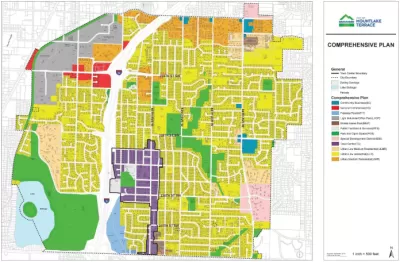
"Mountlake Terrace [Washington] adopted notable changes to its primary urban node, expanding its boundaries and increasing development capacity near its future Link station," report Stephen Fesler.
Mountlake Terrace, located just north of the northern edge of Seattle, joins nearby Lynnwood and Shoreline in overhauling zoning and development regulations near their future stations, according to Fesler. "Edmonds and Everett also doubled down on transit-oriented zoning to make better use of existing high capacity transit investments in their communities, and Snohomish County is in the midst of station area planning in advance of light rail that could result in zoning changes near Ash Way and Mariner Park and Ride–both future Link stations."
Consultant Makers Architecture and Urban Design helped formulate the new subarea for Town Center, as Mountlake Terrace refers to the part of town near the future transit station. Fesler details the substance of the subarea plan as follows:
Much of the existing land use in the Town Center area is residential. The subarea plan highlighted this, indicating that 70% of the acreage is currently in residential use–and 83% of residential land is single-family detached residential use. The zoning changes will help increase development across the new TC-1, TC-2, and TC-3 zones over the next 20 years. The city estimates that Town Center, on the high end, can accommodate up to 8,410 new homes and 1,190,660 square feet of new commercial space. Most of the four-square-mile city will remain single-family zoning even with the more intense changes at the Town Center.
Fesler provides a lot more detail on the various zoning and design regulations included in the new subarea plan. Planetizen previously picked up news about Mountlake Terrace's transit oriented intentions in March 2019.
FULL STORY: Mountlake Terrace Readies Town Center for Light Rail with 12-Story Zoning

Silver Spring Downtown Plan Expanding to Make Room for the Missing Middle
Planners are hoping that by expanding the boundaries of the Silver Spring Downtown Plan in Montgomery County, Maryland, new opportunities for missing middle housing will create new opportunities for housing affordability.

For Lack of Density: Ontario Rejects Toronto's Downtown Plan
Local control loses ground to provincial preemption north of the border.
When Light Rail Comes to Suburban Washington, So Do Bigger Plans
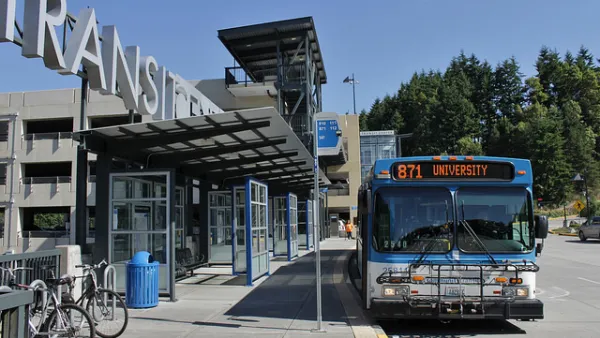
Mountlake Terrace, located about halfway between Seattle and Everett, will soon have new building heights to go along with a new light rail station.

The state-sanctioned urbicide of Austin
People don’t kill cities. Freeways do.

US to reduce Colorado River water deliveries to Mexico
A new Colorado Treaty amendment reduces Mexico’s Colorado River water allocation by 250,000 acre feet.

New Jersey’s second-largest city bans standalone data centers
Jersey City will continue to allow co-location facilities, such as those meant for research institutions that store their own data.

Amtrak not solely to blame for New Jersey commuter rail's unreliability, report finds
A new study from the Garden State Initiative found that NJ Transit’s budget grew 20% across a 4 year period, but reliability declined significantly over the same period.

EPA erases limits on planet-warming pollution from power plants
Under Monday’s plan, power plants would still have some limits on how much mercury, arsenic and other contaminants they can emit.

Phoenix announces new on-demand transit service, more frequent RAPID buses
Both new services will launch in October, and are part of Phoenix's Project Effective Access Solutions for Easing Congestion.

FREE Course: Walkable City 1: Why Walkability?
After describing his path towards focusing on walkability as the essence of good planning, Jeff Speck marches through his five principal reasons for making more walkable places.
Reinventing Malls: Planning Alchemy—Turning Gray Fields Into Gold
The course focuses on the opportunities and imperatives that shape reinvention of mall sites.

Eagle County Government
Harvard University Graduate School of Design
Nashville Planning Department
The Architects Foundation
University of Cincinnati Online
The Pocatello Development Authority
The Urban Renewal Agency of the City of Pocatello
Journal of the American Planning Association