The traditional view of Sansom Street will soon vanish into Philadelphia's past, as the Jewelers Row District makes room for the future.


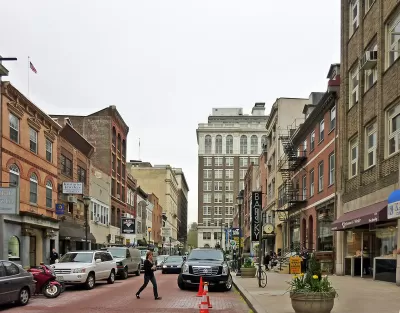
Inga Saffron reports on the final demise of Jewelers' Row in Philadelphia, the oldest diamond center in the United States:
After four years of official dithering at City Hall, preservation lawsuits, and uncertainty, Toll Brothers’ proposal to wedge a glassy 24-story condo onto the Federal-era street is finally a reality. A construction fence now surrounds the five doomed buildings, and demolition is expected to start any day now, followed by two years of construction. When the dust clears, what will be left from the old image?
According to Saffron, not everyone in the Jewelers Row District is entirely pessimistic about the epoch-changing changes coming to the area. There are new businesses in the neighborhood, which has expanded, for instance, while traditional businesses still flourish.
The changes are intended to strengthen this unique place, which remains, despite Toll’s incursion, an authentic, homegrown ecosystem of jewelry designers, fabricators, and retailers, and an important employment cluster for the city. But the decision to broaden its membership is also an acknowledgment that Philadelphia’s historic diamond district isn’t as thick with jewelry shops and makers as it once was. More restaurants have settled on the Row’s main street, the 700 block of Sansom. More property owners are converting the upper floors of their buildings to apartments.
The most pressing question for local businesses is whether they'll persist through the inconveniences of construction as the new development rises in their midst. Still, writes Saffron, Jewelers Row still "conjures up a disappearing Philadelphia…"
Previous Planetizen coverage of Jewelers' Row:
Philadelphia Renaissance Threatens Working Diamond District
- Philadelphia Renaissance Threatens Working Diamond District (October 2016)
- Luxury Condos Versus Philadelphia's Jewelers' Row (April 2015)
FULL STORY: As Toll Brothers starts work on Jewelers Row tower, merchants wonder what’s next | Inga Saffron

Philadelphia Renaissance Threatens Working Diamond District
Heretofore preservationists in the City of Brotherly Love have been focused on finding new uses for vacant, historic buildings, but the city's economic resurgence now threatens five, occupied low-rise buildings city's in vibrant Jewelers Row.
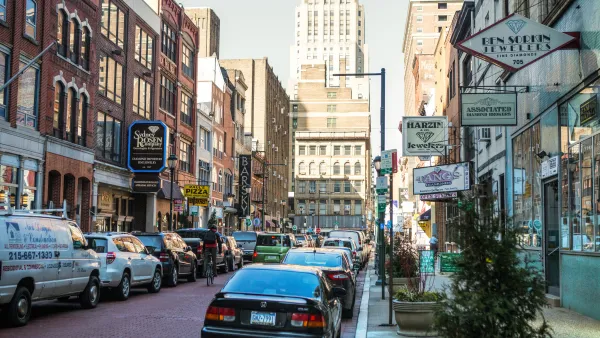
Luxury Condos Versus Philadelphia's Jewelers' Row
Downtown gentrification threatens to displace skilled artisans in a district where workshops go back five generations. Some of the jewelers own their premises, but the rewards for building pricey condos are tempting.
Historic Properties Decay in Philadelphia’s Old City
Old City in Philadelphia presents a troubling dichotomy—while the neighborhood is a busy location for redevelopment investment, many of its historic buildings are succumbing to neglect.

Planetizen Federal Action Tracker
A weekly monitor of how Trump’s orders and actions are impacting planners and planning in America.

The state-sanctioned urbicide of Austin
People don’t kill cities. Freeways do.

US to reduce Colorado River water deliveries to Mexico
A new Colorado Treaty amendment reduces Mexico’s Colorado River water allocation by 250,000 acre feet.

Brightline West’s future may rely on $6 billion federal loan
The company has until Nov. 2 to make a $400 million equity investment into its proposed high-speed rail line.

LA Metro’s ultimatum: no extra buses for LA28 if federal funding isn’t imminently secured
If Metro does not provide additional buses, LA28 organizers will have to find a new way to manage Olympic traffic. LA28’s budget does not include a line item for transit.

Colorado’s Largest Data Center Could Rise Next to Homes — Without a Public Hearing
The proposed campus would consume 11 times the power of Denver International Airport; as it has across the country, opposition mounts.

FREE Course: Walkable City 1: Why Walkability?
After describing his path towards focusing on walkability as the essence of good planning, Jeff Speck marches through his five principal reasons for making more walkable places.
Reinventing Malls: Planning Alchemy—Turning Gray Fields Into Gold
The course focuses on the opportunities and imperatives that shape reinvention of mall sites.

Eagle County Government
Harvard University Graduate School of Design
Nashville Planning Department
The Architects Foundation
University of Cincinnati Online
The Pocatello Development Authority
The Urban Renewal Agency of the City of Pocatello
Journal of the American Planning Association