Rising seas are already impacting drinking water supplies in Miami-Dade County.


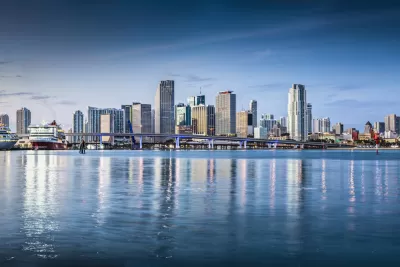
"It’s a gentle intruder, moving stealthily underground, out of sight but not undetected. Salt water continues to move farther inland in Florida’s Miami-Dade County, albeit at a slower rate," writes Brett Walton.
That conclusion evidenced by data collected by newly released maps from the U.S. Geological Survey.
The encroachment of salt water on underground aquifers is especially troubling because of Miami-Dade County's reliance on underground water. "All of Miami-Dade County’s municipal water, which serves several million residents and visitors, comes from groundwater, primarily from a thin lens of fresh water called the Biscayne Aquifer," according to Walton.
The USGS has mapped the boundary between salt and fresh water at the base of the Biscayne Aquifer. "The leading edge of the saltwater layer in the southeastern part of the county, the area of greatest intrusion, moved inland at a pace of 102 meters per year between 2014 and 2018," according to Walton.
FULL STORY: Tracking the Atlantic Ocean’s Inland Creep in Miami-Dade County

'Climate Gentrification' Is Exacerbating Economic Inequality in Miami
A new study shows that over the last several decades the price of real estate has been heavily influenced by the actual and anticipated effects of climate change.
Low-Income Communities Left Behind in the Sea-Level Rise Discussion
The recent Florid King Tide provided more evidence that some communities in Miami-Dade County have been prioritized bin the ongoing response to sea-level rise.

Miami to Launch America's First Fully Electric Bus Rapid Transit Line
The project, led by Miami-Dade County, will link Dadeland South to Florida City via a 20-mile dedicated lane.

Planetizen Federal Action Tracker
A weekly monitor of how Trump’s orders and actions are impacting planners and planning in America.

The state-sanctioned urbicide of Austin
People don’t kill cities. Freeways do.

US to reduce Colorado River water deliveries to Mexico
A new Colorado Treaty amendment reduces Mexico’s Colorado River water allocation by 250,000 acre feet.

Brightline West’s future may rely on $6 billion federal loan
The company has until Nov. 2 to make a $400 million equity investment into its proposed high-speed rail line.

LA Metro’s ultimatum: no extra buses for LA28 if federal funding isn’t imminently secured
If Metro does not provide additional buses, LA28 organizers will have to find a new way to manage Olympic traffic. LA28’s budget does not include a line item for transit.

Colorado’s Largest Data Center Could Rise Next to Homes — Without a Public Hearing
The proposed campus would consume 11 times the power of Denver International Airport; as it has across the country, opposition mounts.

FREE Course: Walkable City 1: Why Walkability?
After describing his path towards focusing on walkability as the essence of good planning, Jeff Speck marches through his five principal reasons for making more walkable places.
Reinventing Malls: Planning Alchemy—Turning Gray Fields Into Gold
The course focuses on the opportunities and imperatives that shape reinvention of mall sites.

Eagle County Government
Harvard University Graduate School of Design
Nashville Planning Department
The Architects Foundation
University of Cincinnati Online
The Pocatello Development Authority
The Urban Renewal Agency of the City of Pocatello
Journal of the American Planning Association