Fast Company details the ambitions of a plan that would add thousands of homes, open space, and commercial development to the home of Google in the Silicon Valley.



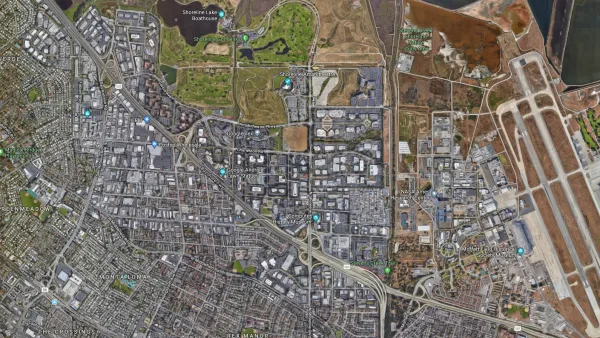
Adele Peters reports on Google's plans to transform its headquarters in Mountain View, California—currently the stereotypical picture of a suburban corporate campus—into a walkable, liveable neighborhood.
[T]he designers working with Google on the redesign hope that it can become a model for turning other pavement-filled suburbs into green spaces where people are less likely to drive," according to Peters.
In addition to 5,700 new homes, "[t]he plan calls for 3.12 million square feet of office space and as much as 400,000 square feet of new retail space along with the homes," according to Peters. "Twenty percent of the housing will be affordable. It’s a response to a plan passed by the city in 2017 that rezoned the area, called the North Bayshore district..."
According to Laura Crescimano, quoted in the article as the founder of Sitelab Urban Studio, the urban design and strategy firm that led the creation of a proposed plan, the plan attempts to address the region's housing shortage as well as reducing car trips.
FULL STORY: Google’s new housing development will get suburban workers out of their cars

Mountain View Goes Big on Google Expansion, Approves 10,000 Housing Units
Could the approval of a massive redevelopment plan for Google property in the city of Mountain View pave the way for a new development-friendly approach to planning in the Silicon Valley and the greater Bay Area?
Google Headquarters Expansion Trips Near the Finish Line
Negotiations between the city of Mountain View and tech giant Google over the latter's plans to expand its headquarters recently took a strange turn.

Google, LinkedIn Complete 'Blockbuster' Land Swap
Big development news for two of the biggest names in the Silicon Valley.

The state-sanctioned urbicide of Austin
People don’t kill cities. Freeways do.

US to reduce Colorado River water deliveries to Mexico
A new Colorado Treaty amendment reduces Mexico’s Colorado River water allocation by 250,000 acre feet.

New Jersey’s second-largest city bans standalone data centers
Jersey City will continue to allow co-location facilities, such as those meant for research institutions that store their own data.

Amtrak not solely to blame for New Jersey commuter rail's unreliability, report finds
A new study from the Garden State Initiative found that NJ Transit’s budget grew 20% across a 4 year period, but reliability declined significantly over the same period.

EPA erases limits on planet-warming pollution from power plants
Under Monday’s plan, power plants would still have some limits on how much mercury, arsenic and other contaminants they can emit.

Phoenix announces new on-demand transit service, more frequent RAPID buses
Both new services will launch in October, and are part of Phoenix's Project Effective Access Solutions for Easing Congestion.

FREE Course: Walkable City 1: Why Walkability?
After describing his path towards focusing on walkability as the essence of good planning, Jeff Speck marches through his five principal reasons for making more walkable places.
Reinventing Malls: Planning Alchemy—Turning Gray Fields Into Gold
The course focuses on the opportunities and imperatives that shape reinvention of mall sites.

Eagle County Government
Harvard University Graduate School of Design
Nashville Planning Department
The Architects Foundation
University of Cincinnati Online
The Pocatello Development Authority
The Urban Renewal Agency of the City of Pocatello
Journal of the American Planning Association