The agency is selling land outside of the city on a commuter rail line in a move that could become more common as a revenue-generating strategy.


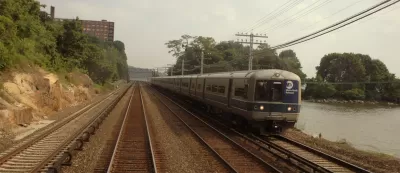
John Surico reports that the Metropolitan Transportation Authority’s Metro-North Railroad has plans to sell a parcel of land in Harrison, New York, in Westchester County. A private developer will build a transit-oriented, mixed-use development that will include apartments, retail space, pedestrian plazas, and parking.
"The New York MTA, the largest transit agency in the U.S., is becoming more familiar with this type of construction. The Hudson Yards project—where the MTA decked over its train yards, and sold the rights to developers for $1 billion to build an entire Manhattan neighborhood on top, with a new subway line extension beneath—is perhaps the largest TOD project in American history," writes Surico.
Still, he notes that the Harrison development differs from projects in the past because the MTA is looking for revenue sources to help fill major budget gaps. "So the agency is eyeing projects in suburban communities outside of Manhattan, with the hopes that the prospect of economic development will prod smaller towns to plot their futures near its train stations."
FULL STORY: When a Transit Agency Becomes a Suburban Developer

New York MTA Seeks Federal Funding Relief as Ridership Plummets
The Metropolitan Transportation Authority has seen significant ridership drops due to the coronavirus. The agency is asking Congress for $4 billion to help it through the crisis.
Op-Ed: Toll Revenues Could Fix Aging New York-Connecticut Rail Connection
Rather than bonds, an op-ed makes the case for electronic tolls to pay for improvements to commuter rail lines between New York City and Connecticut.
NYC to Upgrade 1/3 of its Subway Car Fleet
The MTA is seeking proposals for up to 2,390 new subway cars to upgrade its aging fleet.

Planetizen Federal Action Tracker
A weekly monitor of how Trump’s orders and actions are impacting planners and planning in America.

The state-sanctioned urbicide of Austin
People don’t kill cities. Freeways do.

US to reduce Colorado River water deliveries to Mexico
A new Colorado Treaty amendment reduces Mexico’s Colorado River water allocation by 250,000 acre feet.

5 New England states march closer to 800 megawatt wind energy project
Securing federal approval for the project may be complicated under the Trump administration, which has historically been hostile towards domestic wind power.

Baltimore to break ground on $50 million Transit Priority Project
The project will bring faster bus trips, safer streets and better bike connections to Baltimore.

Airbnb launches $250 million 'last-dollar financing' housing accelerator, makes first investment in Austin
The company will put $6.4 million towards affordable housing development in Texas’ capital.

FREE Course: Walkable City 1: Why Walkability?
After describing his path towards focusing on walkability as the essence of good planning, Jeff Speck marches through his five principal reasons for making more walkable places.
Reinventing Malls: Planning Alchemy—Turning Gray Fields Into Gold
The course focuses on the opportunities and imperatives that shape reinvention of mall sites.

Eagle County Government
Harvard University Graduate School of Design
Nashville Planning Department
The Architects Foundation
University of Cincinnati Online
The Pocatello Development Authority
The Urban Renewal Agency of the City of Pocatello
Journal of the American Planning Association