In attempt to design buildings that convey the complexity and scale of the traditional Main Street, we frequently end up with buildings that are a cartoon version of the real thing. Perhaps we are trying too hard?



Like the McMansion that attempts to mimic the complex roof massing of an entire French village in a single building, the "McMain Street" attempts to mimic the fine-grained, vertically proportioned facades of the traditional American Main Street—all in a single building. And, more often than not, like the McMansion, the end result appears contrived and inauthentic.
In large part, the ubiquity of this building type has been brought about by well-intentioned planners who encourage (or require) architects to disguise large buildings as an assemblage of smaller buildings. On occasions the illusion works, but more often than not, we are left with a cartoon version of Main Street.
The article explores the prevalence of the McMain Street building and offers alternatives and recommendations on how to get better results when dealing with large buildings.
FULL STORY: From McMansion to McMain Street

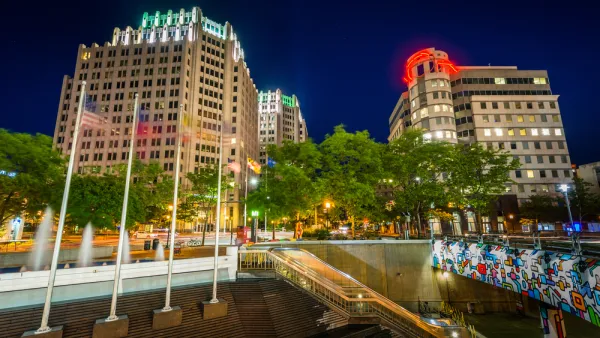
Zoning Changes Would Allow Transit-Oriented Multi-Family Development in Montgomery County
Montgomery County, Maryland wants to put its zoning where its transit is—it's just the latest in a string of transit-oriented land use reforms for the famously suburban county.

Houston's pedestrian promenade on track to be ready for World Cup crowds
The city is transforming seven downtown blocks along a light rail line into a car-free zone focused on outdoor dining and entertainment.
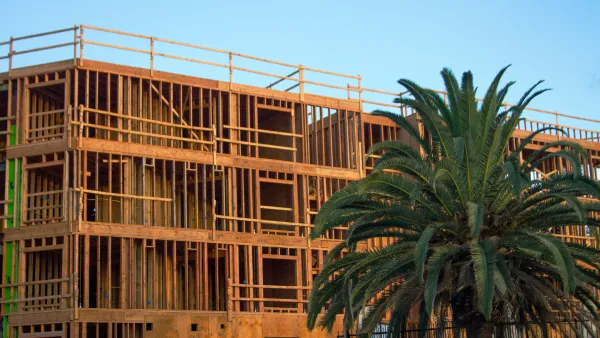
Five Years of California’s Landmark Land Use Law, SB 35
It’s been five years since the California Legislature approved Senate Bill 35 to clear hurdles to housing construction. How much of its intentions has the law accomplished, and what should planners look for in the next few years?

Planetizen Federal Action Tracker
A weekly monitor of how Trump’s orders and actions are impacting planners and planning in America.

The state-sanctioned urbicide of Austin
People don’t kill cities. Freeways do.

US to reduce Colorado River water deliveries to Mexico
A new Colorado Treaty amendment reduces Mexico’s Colorado River water allocation by 250,000 acre feet.

5 New England states march closer to 800 megawatt wind energy project
Securing federal approval for the project may be complicated under the Trump administration, which has historically been hostile towards domestic wind power.

Baltimore to break ground on $50 million Transit Priority Project
The project will bring faster bus trips, safer streets and better bike connections to Baltimore.

Airbnb launches $250 million 'last-dollar financing' housing accelerator, makes first investment in Austin
The company will put $6.4 million towards affordable housing development in Texas’ capital.

FREE Course: Walkable City 1: Why Walkability?
After describing his path towards focusing on walkability as the essence of good planning, Jeff Speck marches through his five principal reasons for making more walkable places.
Reinventing Malls: Planning Alchemy—Turning Gray Fields Into Gold
The course focuses on the opportunities and imperatives that shape reinvention of mall sites.

Eagle County Government
Harvard University Graduate School of Design
Nashville Planning Department
The Architects Foundation
University of Cincinnati Online
The Pocatello Development Authority
The Urban Renewal Agency of the City of Pocatello
Journal of the American Planning Association