With no shot at a new ballpark in Tampa, and pressure mounting to relocate the team to Portland, Oregon, among other possibilities, the Tampa Bay Rays could still end up at a new location in St. Petersburg.


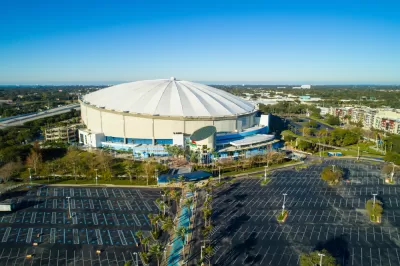
"With plans for an Ybor City ballpark trashed by Major League Baseball and buried by the team, any hope for building a local home for the Tampa Bay Rays now appears focused on St. Petersburg," report Charlie Frago and Josh Solomon.
Meanwhile the city of Portland in Oregon is also working up plans for a waterfront ballpark to lure the team westward. Other cities, Montreal, Las Vegas, Charlotte, San Antonio and Nashville, are also considered in the running to land the team, according to the article.
The city of St. Petersburg is already plotting what to do next with the current home of the Tampa Bay Rays, which sits on prime redevelopment land. That Tropicana Field property is a key bargaining chip in the city of St. Petersburg's moves to keep the team in the city. If and when the team's three-year window to look at other stadium locations expires at the end of the year, the team will likely be locked into its lease of Tropicana Field until 2027.
FULL STORY: Tampa Bay Rays stadium options now largely in St. Pete

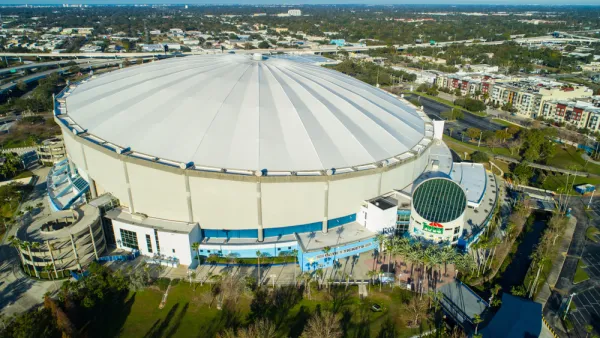
No Breakthroughs in the Search for a New Place to House the Tampa Bay Rays
Finding a new home for a major league baseball team isn't as easy as it used to be in Florida.
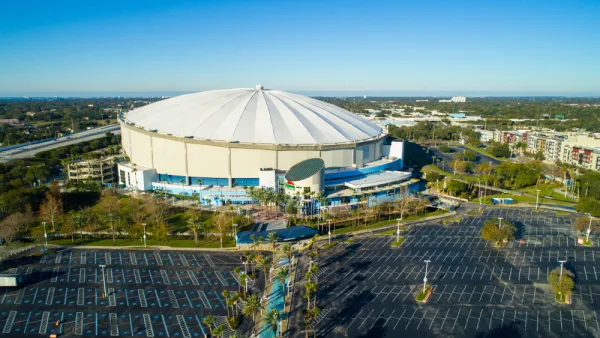
St. Petersburg Planning for a Post-Baseball Future
The Tampa Bay Rays still play at Tropicana Field, but they won't forever. The redevelopment opportunity for the site will be a game changer for the city.
Waterfront Ballpark Plans in the Work in Portland
The Portland Diamond Project is trying to bring Major League Baseball to Portland.

Planetizen Federal Action Tracker
A weekly monitor of how Trump’s orders and actions are impacting planners and planning in America.

The state-sanctioned urbicide of Austin
People don’t kill cities. Freeways do.

US to reduce Colorado River water deliveries to Mexico
A new Colorado Treaty amendment reduces Mexico’s Colorado River water allocation by 250,000 acre feet.

Baltimore to break ground on $50 million Transit Priority Project
The project will bring faster bus trips, safer streets and better bike connections to Baltimore.

Airbnb launches $250 million 'last-dollar financing' housing accelerator, makes first investment in Austin
The company will put $6.4 million towards affordable housing development in Texas’ capital.

Guerilla urbanists are building DIY bus stop benches in Chicago
A before-and-after of one of the bus stops with a new bench. The new benches are not officially sanctioned or permitted, but the residents who placed them hope they will be the start of a network of DIY benches across the city.

FREE Course: Walkable City 1: Why Walkability?
After describing his path towards focusing on walkability as the essence of good planning, Jeff Speck marches through his five principal reasons for making more walkable places.
Reinventing Malls: Planning Alchemy—Turning Gray Fields Into Gold
The course focuses on the opportunities and imperatives that shape reinvention of mall sites.

Eagle County Government
Harvard University Graduate School of Design
Nashville Planning Department
The Architects Foundation
University of Cincinnati Online
The Pocatello Development Authority
The Urban Renewal Agency of the City of Pocatello
Journal of the American Planning Association