Take a tour of Elon Musk's idea for fixing Los Angeles congestion.


After news broke earlier this week that the Boring Co.'s work in Hawthorne, California would make its debut on Tuesday, reports of the experience are starting to roll in.
First, Laura J. Nelson provides a review of the experience. Included in the article is the most complete video of the tunnel's performance, showing point of view, tunnel view, and Elon Musk commentary view as a modified Tesla Model X cruises through the tunnel at 53 mph (not the promised 150 mph).
"The trip through the tunnel took about two minutes, illuminated by the car’s headlights and a strip of blue neon lights tacked to the ceiling. The Model X rolled on two molded concrete shelves along the wall, which were so uneven in places that it felt like riding on a dirt road," according to Nelson. All in all, the Boring Co. has only provided a bumpy ride so far, according to Nelson.
According to an article by Alissa Walker, who also attended the opening, the experience of the tunnel so far is reminiscent of Disneyland. "The tunnel itself—painted white and installed with lighting that changes colors—as well as the spectacle surrounding the tunnel’s opening, was not unlike the opening of a new ride at Disneyland."
Then there's the perhaps most consequential opinion: that of Chicago Alderman Gilbert Villegas. The "Chicago alderman who was able to take a ride in an underground transportation tunnel built by tech entrepreneur Elon Musk said he still has 'a lot of questions' about how such a tube could be built in Chicago," according to an article by Mary Wisniewksi. The opinions of Chicago aldermen are extremely relevant to the prospects of the Boring Company's profitability, and Musk's ideas about transportation to the future of mobility. "In June, Mayor Rahm Emanuel and Musk announced plans for an express, high-speed, underground connection between downtown and O’Hare International airport," according to Wisniewksi.
FULL STORY: Elon Musk unveils his company’s first tunnel in Hawthorne, and it’s not a smooth ride

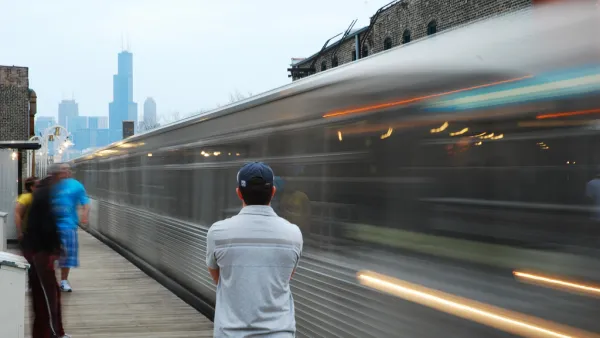
Chicago's New Train to O'Hare Won't Be a Train—It's Elon Musk's 'Loop'
Loop, as in a derivation of Hyperloop, conceived by Elon Musk and to be built by his newest venture, The Boring Company, is the technology of choice for high-speed transit to O'Hare Airport.
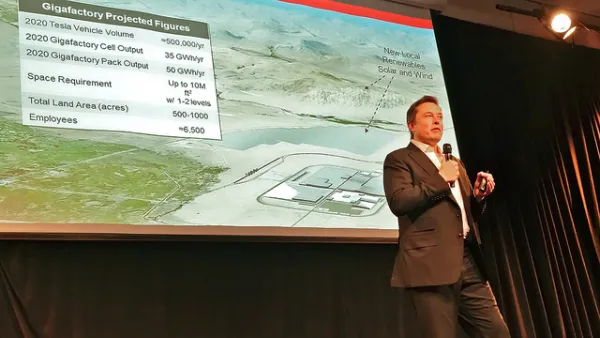
Behold: Elon Musk's First Tunnel
Take a first look at the fruits of the Boring Company's labor. According to Elon Musk, the tunnel will be open to the public for free rides later this year.

Two Boring Co. Projects Appear to Bite the Dust
References to the Dugout Loop, in Los Angeles, and the Baltimore-to-Washington Loop have been removed from the Boring Company's website.

Planetizen Federal Action Tracker
A weekly monitor of how Trump’s orders and actions are impacting planners and planning in America.

The state-sanctioned urbicide of Austin
People don’t kill cities. Freeways do.

US to reduce Colorado River water deliveries to Mexico
A new Colorado Treaty amendment reduces Mexico’s Colorado River water allocation by 250,000 acre feet.

5 New England states march closer to 800 megawatt wind energy project
Securing federal approval for the project may be complicated under the Trump administration, which has historically been hostile towards domestic wind power.

Baltimore to break ground on $50 million Transit Priority Project
The project will bring faster bus trips, safer streets and better bike connections to Baltimore.

Airbnb launches $250 million 'last-dollar financing' housing accelerator, makes first investment in Austin
The company will put $6.4 million towards affordable housing development in Texas’ capital.

FREE Course: Walkable City 1: Why Walkability?
After describing his path towards focusing on walkability as the essence of good planning, Jeff Speck marches through his five principal reasons for making more walkable places.
Reinventing Malls: Planning Alchemy—Turning Gray Fields Into Gold
The course focuses on the opportunities and imperatives that shape reinvention of mall sites.

Eagle County Government
Harvard University Graduate School of Design
Nashville Planning Department
The Architects Foundation
University of Cincinnati Online
The Pocatello Development Authority
The Urban Renewal Agency of the City of Pocatello
Journal of the American Planning Association