Several states, and even the federal government, are considering adopting carbon pricing plans.


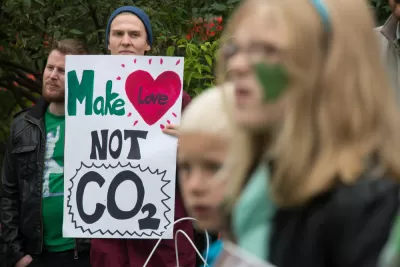
Seven or more states are close to enacting or expanding carbon pricing within the next year, Marianne Lavelle reports in InsideClimate News. Together with the states that already price fossil fuels, "they would account for 22 percent of U.S. carbon emissions, 34 percent of the U.S. population, and 41 percent of U.S. GDP."
The states considering a price on carbon—including Oregon, Massachusetts, and New York—already have relatively low-carbon economies, and also face "clear, pressing economic and human risks from climate change," like sea-level rise, drought, and fire.
The fate of a national plan to tax carbon, introduced in Congress by a bipartisan group of legislators, may depend on whether state-level programs continue to gather momentum, Lavelle writes.
Read the full story: A Carbon Tax Wave? 7 States Considering Carbon Pricing to Fight Climate Change
FTA Kills ‘Social Cost of Carbon’ in Transit Grant Criteria
The Capital Investments Grant program will no longer factor in the future impacts of carbon emissions.
Study: D.C. Region Must Take Aggressive Steps To Reach Climate Goal
To achieve its stated emissions reduction goal, the Greater Washington area must sharply reduce driving and speed up the adoption of electric vehicles.
Can Emissions Reductions Last Beyond the Pandemic?
The dramatic reductions in carbon emissions during the last year only highlight how drastically humans must change behavior to meet climate goals.

Planetizen Federal Action Tracker
A weekly monitor of how Trump’s orders and actions are impacting planners and planning in America.

California plans to bury El Niño’s downpour
If the state plays its cards right, it may be able to store a billion acre-feet of El Niño’s water in aquifers.

Desperate measures: Advocates weigh draining Lake Powell to fill Colorado River
Draining the reservoir could reduce evaporation losses by a couple hundred thousand acre-feet.

In Texas, data centers are swallowing promised parkland
Residents who moved to Taylor, Texas for a rural community now have to contend with three data centers in their backyard.

How a Chicago-sized wind farm beat the odds and powered on
The project spanned five presidential administrations and a standoff with a U.S. military base.

MTA gives itself 30 days to transform pit into basketball court
The site has been under construction since 2022; the city originally estimated it would finish the court in 2024.

FREE Course: Walkable City 1: Why Walkability?
After describing his path towards focusing on walkability as the essence of good planning, Jeff Speck marches through his five principal reasons for making more walkable places.
Reinventing Malls: Planning Alchemy—Turning Gray Fields Into Gold
The course focuses on the opportunities and imperatives that shape reinvention of mall sites.

City of Rosemead
Rutgers University, Edward J. Bloustein School of Planning and Public Policy
One Hundred Miles
Hunter College, City University of New York (CUNY)
The Architects Foundation
University of Cincinnati Online
City of Cambridge
Montrose County
The Pocatello Development Authority