Storm resilience is a key design element of Hunter’s Point South Park in New York.


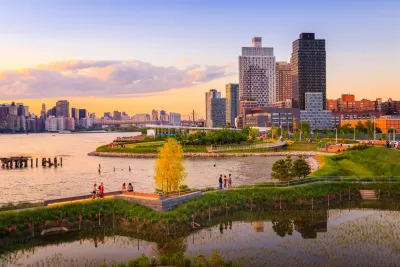
Karim Doumar reports on Hunter’s Point South Park, an 11-acre park that has transformed what was once a waterfront industrial area in Long Island City, Queens. The park includes storm resilient design features, which Doumar says have already proven successful:
As phase one neared completion in 2012, Hurricane Sandy and its 4-foot storm surge inundated the entire thing. And then, calmly and with great precision, the water drained right back out into the river at a pace the sewer system could handle, leaving the park intact. Construction resumed just days later.
The second phase, which opened in June, has also been designed to withstand storm effects. “Instead of concrete walls and buttresses guarding the plot from the river, this park is the river’s friend. Twice a day, as the high tide rolls in, Hunters Point South Park becomes a marsh,” says Doumar. Future plans for the surrounding area include 5,000 units of housing for middle- and low-income residents.
For now, says Doumar, Hunter’s Point South Park is an example of how green infrastructure can be a successful buffer against the forces of nature while also providing recreational space. “Instead of concrete buttresses that once dominated the riverside, Hunters Point South Park’s relationship with the river is dominated by slow, rocky descents into the sea, and a tide that works with the landscape.”
FULL STORY: A Storm-Resilient Park in Queens


Planetizen Federal Action Tracker
A weekly monitor of how Trump’s orders and actions are impacting planners and planning in America.

The state-sanctioned urbicide of Austin
People don’t kill cities. Freeways do.

US to reduce Colorado River water deliveries to Mexico
A new Colorado Treaty amendment reduces Mexico’s Colorado River water allocation by 250,000 acre feet.

Mamdani overhauls NYC's Vision Zero plan with 100 new policy goals
The overhaul aims to reduce traffic deaths and make streets safer for pedestrians, cyclists and drivers through lower speed limits, new safety infrastructure and more.

Amtrak not solely to blame for New Jersey commuter rail's unreliability, report finds
A new study from the Garden State Initiative found that NJ Transit’s budget grew 20% across a 4 year period, but reliability declined significantly over the same period.

EPA erases limits on planet-warming pollution from power plants
Under Monday’s plan, power plants would still have some limits on how much mercury, arsenic and other contaminants they can emit.

FREE Course: Walkable City 1: Why Walkability?
After describing his path towards focusing on walkability as the essence of good planning, Jeff Speck marches through his five principal reasons for making more walkable places.
Reinventing Malls: Planning Alchemy—Turning Gray Fields Into Gold
The course focuses on the opportunities and imperatives that shape reinvention of mall sites.

Eagle County Government
Harvard University Graduate School of Design
Nashville Planning Department
The Architects Foundation
University of Cincinnati Online
The Pocatello Development Authority
The Urban Renewal Agency of the City of Pocatello
Journal of the American Planning Association