The news keeps getting worse at San Francisco's newly opened, since closed, Salesforce Transit Center.


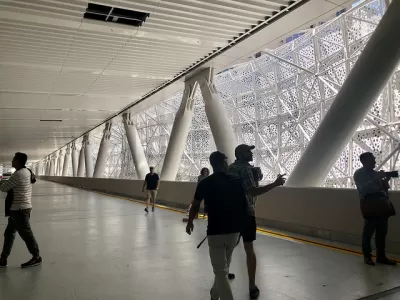
After barely more than a month of operation, the $2.2 billion Salesforce Transit Center was closed in September after inspectors discovered cracks in two of the building's four steel support beams.
Since then, the legal and political drama has taken hold.
"San Francisco city officials are withholding $9.6 million meant to fund expansion planning for the Salesforce Transit Center, in a bid to hold its leadership accountable for alleged mismanagement of the $2.2 billion project," reported Joe Fitzgerald Rodriguez on October 18.
"That funding was aimed toward design and engineering of a planned future phase of the transit center, in which the basement floor will be converted to accommodate California High Speed Rail and a soon-to-be electrified Caltrain," adds Fitzgerald Rodriguez. (There's more on the threat to future planning efforts later in this article).
News of the city's reluctance to continue funding the project came a day after news of a lawsuit, reported by Rachel Swan, over mismanagement of the project. That lawsuit doesn't even mention the cracked beams. Swan explains:
The suit covers the $2.2 billion center’s construction phase and makes no mention of the current problems facing the facility....But the action is the latest in a series of lawsuits stemming from the project’s delays and cost overruns, and it blames the authority for “mismanagement, failures, and delays.”
Fast forward to this week, when the San Francisco County Transportation Authority Board voted to finalize the decision to suspend funding for next planning steps for the project "until The City can evaluate what led to the discovery last month of cracks in two steel beams, shutting down the newly constructed $2.2 billion transit center," according to the most recent article on the subject from Fitzgerald Rodriguez.
From another article by Rachel Swan comes more bad news that testing of the cracked steel beams has been delayed—results are now expected back in mid-November. "Only then can officials determine what happened and how to fix it, said Mark Zabaneh, executive director of the Joint Powers Authority, speaking to the authority Tuesday. A reopening date has not been set," according to Swan.
Read the full story: City withholds Salesforce Transit Center funding as allegations of mismanagement mount

Cracked Beams Repaired, S.F.'s Transbay Transit Center Ready to Reopen
Buses and people will soon return to the Transbay Transit Center, which operated for just over a month at the end of 2018 before structural flaws forced the closure of the facility for inspections and repairs.
S.F.'s Transbay Transit Center Won't Reopen Until June at the Earliest
The Transbay Transit Center, opened for a brief stint in the latter half of 2018 before structural flaws were discovered, won't be open to the public again anytime soon.
Report: Rebranding Needed for Next Phase of the Transbay Transit Center
A team of experts suggests that a rebranding and potentially a new entity to oversee construction will be necessary to finish phase two fo the Transbay transit center.

Planetizen Federal Action Tracker
A weekly monitor of how Trump’s orders and actions are impacting planners and planning in America.

California plans to bury El Niño’s downpour
If the state plays its cards right, it may be able to store a billion acre-feet of El Niño’s water in aquifers.

Desperate measures: Advocates weigh draining Lake Powell to fill Colorado River
Draining the reservoir could reduce evaporation losses by a couple hundred thousand acre-feet.

Housing is the top priority of Seattle’s sole new councilmember
Jenks campaigned on building 1,000 new units of affordable housing.

New tax cuts may slash $1.5 billion in funding for Miami transit, public parks
Amendment 3 will save Miami-Dade homeowners $2,700 in 2028.

Arizona, Wisconsin, Pennsylvania hope to finally advance climate goals post-midterms
The three states have spent years under Republican or divided control.

FREE Course: Walkable City 1: Why Walkability?
After describing his path towards focusing on walkability as the essence of good planning, Jeff Speck marches through his five principal reasons for making more walkable places.
Reinventing Malls: Planning Alchemy—Turning Gray Fields Into Gold
The course focuses on the opportunities and imperatives that shape reinvention of mall sites.

City of Rosemead
Rutgers University, Edward J. Bloustein School of Planning and Public Policy
One Hundred Miles
University of Michigan School for Environment and Sustainability (SEAS)
Hunter College, City University of New York (CUNY)
The Architects Foundation
City of Cambridge
Montrose County
The Pocatello Development Authority