Mayor Anne Hidalgo's efforts to improve air quality by reducing car trips in the city of Paris are paying off.


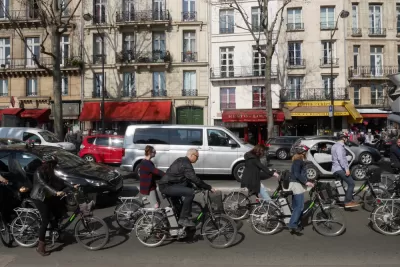
Simon MacMichael reports from Paris, where the number of automobiles operating in the city is on the decline.
"The first five months of 2018 have seen the number of vehicles fall 6.5 per cent against the comparable period last year," reports MacMichael, sharing figures released recently by the city. "February saw the sharpest drop, with 705 vehicles recorded per kilometre per hour, down 11.4 per cent on the same month in 2017."
"The figures are being hailed as continuing proof of city hall’s efforts to fight air pollution, including a reform of paid parking, and reflect an acceleration of an existing trend that saw traffic fall by 3 per cent from 2003 to 2014 and by 4 per cent in the subsequent two years," according to MacMichael.
The articles include a lot more detail on the vehicle numbers, including details like number of vehicles traveling during the morning and commute and along specific streets.
Read the full story: Mayor of Paris: Cycle lanes have helped slash car use in French capital

French Suburbs Join Paris in Diesel Ban
The ban on diesel cars now extends well beyond the city of Paris.
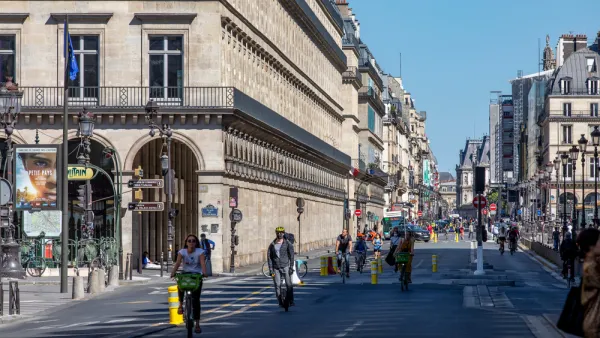
Paris Plans to Become a '100 Percent Cyclable' City
Mayor Anne Hidalgo continues her commitment to making Paris more bikeable with a new plan that will improve bike parking and facilities in the French capital.
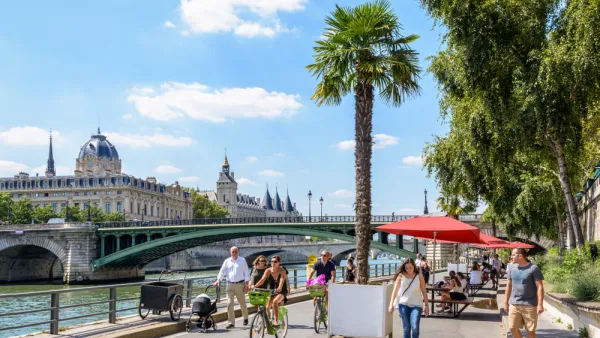
The Car-Free Revolution Continues in Paris
The city continues to reclaim space for pedestrians and cyclists.

Planetizen Federal Action Tracker
A weekly monitor of how Trump’s orders and actions are impacting planners and planning in America.

California plans to bury El Niño’s downpour
If the state plays its cards right, it may be able to store a billion acre-feet of El Niño’s water in aquifers.

Chicago breaks ground on $3 billion megadevelopment
The new neighborhood, titled Foundry Park, will one day host 3,700 residences.

California High-Speed Rail Authority CEO resigns after $600,000 scandal
Under Ian Choudri, the authority used taxpayer dollars to fund first class flights and trips to nightclubs.

Want to study the Missouri River? Soon, you may need unanimous approval from 10 states
Legislation would require 10 governors’ permission to study or build projects moving water outside the basin.

Desperate measures: Advocates weigh draining Lake Powell to fill Colorado River
Draining the reservoir could reduce evaporation losses by a couple hundred thousand acre-feet.

FREE Course: Walkable City 1: Why Walkability?
After describing his path towards focusing on walkability as the essence of good planning, Jeff Speck marches through his five principal reasons for making more walkable places.
Reinventing Malls: Planning Alchemy—Turning Gray Fields Into Gold
The course focuses on the opportunities and imperatives that shape reinvention of mall sites.

City of Rosemead
Rutgers University, Edward J. Bloustein School of Planning and Public Policy
One Hundred Miles
Hunter College, City University of New York (CUNY)
The Architects Foundation
University of Cincinnati Online
City of Cambridge
Montrose County
The Pocatello Development Authority