Once, trains dominated the city’s economy, now it's "brains, bikes and beer," according to city officials.


Roanoke, Virginia was once the site of a large rail freight hub, but as that industry moved, the city had to transition. The city made big investments in its water utilities to try to attract the food industry. "With the merger of the city and county utilities, and later with the two systems in Botetourt and Franklin counties, the new authority doubled Roanoke's capacity to supply water and to treat wastewater," J. Brian Charles reports for Governing.
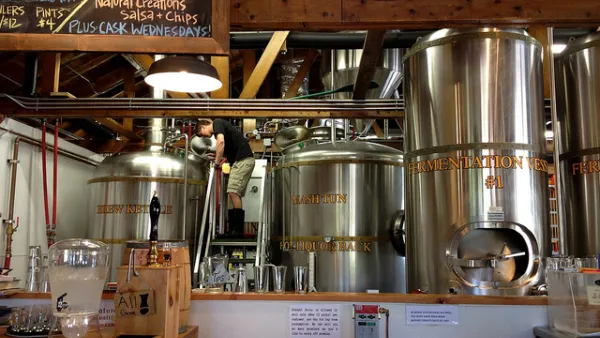
Treating waste water is key to the production of beer, and "at least 15 breweries have opened in and around Roanoke in the past six years," Charles writes. But unlike Missoula, Montana and other brewing hot spots, Roanoke breweries aren't just home-grown operations. "Roanoke has also landed full-scale production facilities from beer companies with breweries in other cities. San Diego-based Ballast Point, for example, opened a new brewery just outside Roanoke last summer with 100 employees and the current capacity to produce 200,000 barrels of beer a year -- a number that's expected to grow," Charles reports.
FULL STORY: Beer Boom: How One City Used Suds to Brew Up a New Economy

A Montana College Town's Beer Economy
Missoula, Montana is home to seven craft brewers, and two more are in the works. The small town has seen development and jobs from these local businesses, but some fear market saturation.

Small 'maker' businesses are good for downtowns — and data proves it
Small-scale manufacturers tend to be more engaged in the local supply chain, contributing to economic revitalization.

Everything you Need to Know from the APA’s 2026 Trend Report for Planners
Plus, a conversation with the APA’s Chief Foresight and Knowledge Officer, Petra Hurtado.

The state-sanctioned urbicide of Austin
People don’t kill cities. Freeways do.

US to reduce Colorado River water deliveries to Mexico
A new Colorado Treaty amendment reduces Mexico’s Colorado River water allocation by 250,000 acre feet.

New Jersey’s second-largest city bans standalone data centers
Jersey City will continue to allow co-location facilities, such as those meant for research institutions that store their own data.

Amtrak not solely to blame for New Jersey commuter rail's unreliability, report finds
A new study from the Garden State Initiative found that NJ Transit’s budget grew 20% across a 4 year period, but reliability declined significantly over the same period.

EPA erases limits on planet-warming pollution from power plants
Under Monday’s plan, power plants would still have some limits on how much mercury, arsenic and other contaminants they can emit.

Phoenix announces new on-demand transit service, more frequent RAPID buses
Both new services will launch in October, and are part of Phoenix's Project Effective Access Solutions for Easing Congestion.

FREE Course: Walkable City 1: Why Walkability?
After describing his path towards focusing on walkability as the essence of good planning, Jeff Speck marches through his five principal reasons for making more walkable places.
Reinventing Malls: Planning Alchemy—Turning Gray Fields Into Gold
The course focuses on the opportunities and imperatives that shape reinvention of mall sites.

Eagle County Government
Harvard University Graduate School of Design
Nashville Planning Department
The Architects Foundation
University of Cincinnati Online
The Pocatello Development Authority
The Urban Renewal Agency of the City of Pocatello
Journal of the American Planning Association