A literature review of the factors influencing public transit ridership.



The need for greater understanding about the factors influencing the rise and fall of transit ridership has never been greater, as population grows, housing costs soar and housing construction continues its push, transit agencies tighten their belts, and new technology disrupts assumptions about mobility as a service.
"Transit and elected officials experiencing ridership losses in recent years need to better understand what’s causing those declines before they can reverse them," according to an article by Mary Buchanan. "But recognizing the factors that drive ridership down is not always simple."
To help in building a greater understanding of the trends and forces that influence transit ridership, Buchanan offers a survey of literature on the subject, searching through several categories of inquiry: gas prices, other costs of driving, transportation network companies, other external factors, transit affordability, the usefulness of transit, and safety.
Read the full story: Lessons on Ridership, from the National Literature

Study Examines Bike Share Programs' Effect on Transit Ridership
Some good news, and some bad, on the effect of bike-share programs on transit ridership.

Study: Crime Concerns Cause Transit's Gender Gap
A new study of transit use in Los Angeles finds safety concerns are keeping women off of public transit.
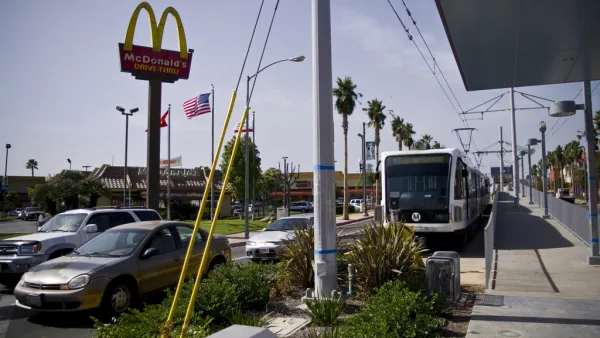
Southern California's Declining Transit Ridership, Explained
More Southern Californians are purchasing motor vehicles, particularly those who were previously transit-dependent, which largely explains the region's declining transit ridership, according to a newly released study.

Planetizen Federal Action Tracker
A weekly monitor of how Trump’s orders and actions are impacting planners and planning in America.

California plans to bury El Niño’s downpour
If the state plays its cards right, it may be able to store a billion acre-feet of El Niño’s water in aquifers.

Desperate measures: Advocates weigh draining Lake Powell to fill Colorado River
Draining the reservoir could reduce evaporation losses by a couple hundred thousand acre-feet.

Seattle passes record-breaking transit services expansion
Proposition 1 will double the city’s transit tax to add 95,000 more bus trips and preserve 180,000 bus trips annually.

Post election, Texas is no longer Musk’s 'AI oasis'
Elon Musk dolled out $446 million on the 2026 midterms, the most ever spent by a non-canidate.

Chicago voters approve permanent festival grounds, penalty for vacant property owners
Currently, major summer and fall festivals take over public parks for weeks at a time, drawing criticism from nearby residents

FREE Course: Walkable City 1: Why Walkability?
After describing his path towards focusing on walkability as the essence of good planning, Jeff Speck marches through his five principal reasons for making more walkable places.
Reinventing Malls: Planning Alchemy—Turning Gray Fields Into Gold
The course focuses on the opportunities and imperatives that shape reinvention of mall sites.

City of Rosemead
Rutgers University, Edward J. Bloustein School of Planning and Public Policy
One Hundred Miles
Hunter College, City University of New York (CUNY)
The Architects Foundation
University of Cincinnati Online
City of Cambridge
Montrose County
The Pocatello Development Authority