The Internet of Things faces down crumbling infrastructure with an offering from AT&T designed to reduce the cost of manual inspections.


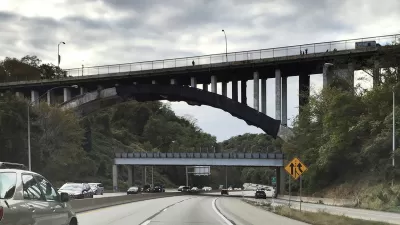
While the federal government's intentions on infrastructure remain frustratingly vague, other actors are stepping forward to shore things up. Telecommunications companies for instance. For a price, AT&T's Smart Cities Structure Monitoring system will harness "Internet of Things" tech to monitor the structural soundness of bridges and railroads.
Katie Pyzyk writes, "Battery-operated sensors will monitor structural factors such as cracks, temperature, joint movement and angle changes. The system will take readings every eight hours and send information — including alerts about unsafe structures — to city leaders."
AT&T is marketing the system as a way for cities to save. "Despite the ongoing costs, the automated system has the potential to be more reasonable than consistently performing manual infrastructure inspections and analyses."
Pyzyk goes on, "Municipalities that purchase the system have the option to manage it themselves or to contract with AT&T for management services."
FULL STORY: AT&T will launch IoT service to monitor bridge, railway safety


Smart Cities and Utilities: Enhancing Energy Efficiency Through IoT Integration
Learn how IoT integration in utilities is boosting energy efficiency in smart cities, aiding urban planners in sustainable development.

How Smart Cities Influence Real Estate Investment
By integrating technology and infrastructure, smart cities are attracting investors with their potential for improved quality of life, efficient resource management, and innovative urban development projects.

Toyota Working on the Smartest City Yet, Built From Scratch
Checking in with Toyota's plans for an interconnected smart "city of the future" means considering how their approach might differ from other attempts at similar projects.

The state-sanctioned urbicide of Austin
People don’t kill cities. Freeways do.

US to reduce Colorado River water deliveries to Mexico
A new Colorado Treaty amendment reduces Mexico’s Colorado River water allocation by 250,000 acre feet.

New Jersey’s second-largest city bans standalone data centers
Jersey City will continue to allow co-location facilities, such as those meant for research institutions that store their own data.

Amtrak not solely to blame for New Jersey commuter rail's unreliability, report finds
A new study from the Garden State Initiative found that NJ Transit’s budget grew 20% across a 4 year period, but reliability declined significantly over the same period.

EPA erases limits on planet-warming pollution from power plants
Under Monday’s plan, power plants would still have some limits on how much mercury, arsenic and other contaminants they can emit.

Phoenix announces new on-demand transit service, more frequent RAPID buses
Both new services will launch in October, and are part of Phoenix's Project Effective Access Solutions for Easing Congestion.

FREE Course: Walkable City 1: Why Walkability?
After describing his path towards focusing on walkability as the essence of good planning, Jeff Speck marches through his five principal reasons for making more walkable places.
Reinventing Malls: Planning Alchemy—Turning Gray Fields Into Gold
The course focuses on the opportunities and imperatives that shape reinvention of mall sites.

Eagle County Government
Harvard University Graduate School of Design
Nashville Planning Department
The Architects Foundation
University of Cincinnati Online
The Pocatello Development Authority
The Urban Renewal Agency of the City of Pocatello
Journal of the American Planning Association