Should cities with some of the worst air pollution in the country be adding massive campuses for logistics and heavy industries?


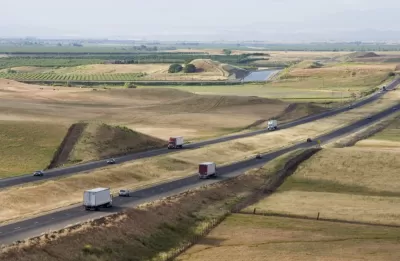
"This Thursday the Fresno City Council will vote on a proposal for a major new industrial development in south Fresno," reports Joe Moore.
The proposal strikes at a core set of issues driving planning decisions in the California Central Valley—economic development catering to the logistics industry in a city with ongoing unemployment challenges, which is likely to exacerbate air pollution challenges that impact public health throughout the region.
According to an article and radio segment by Moore, the proposed development would be built on 110 acres and "would allow up to 2,000,000 square feet of new construction for heavy industry." Such developments are a goal of Mayor Lee Brand's administration as it attempts to lower unemployment in the city. However, the development and others like it, "could result in increased air pollution from all the trucks that bring goods in and out of the facilities."
Read the full story: More Jobs Or More Pollution? Plan For New Industrial Park In Fresno Draws Opposition
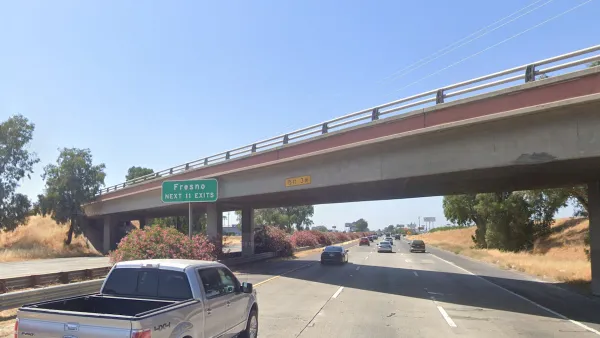
Transportation Secretary Orders Review of Fresno Highway Project
The decision follows a lawsuit by local groups who say Caltrans should not have exempted two interchange expansions from environmental review.
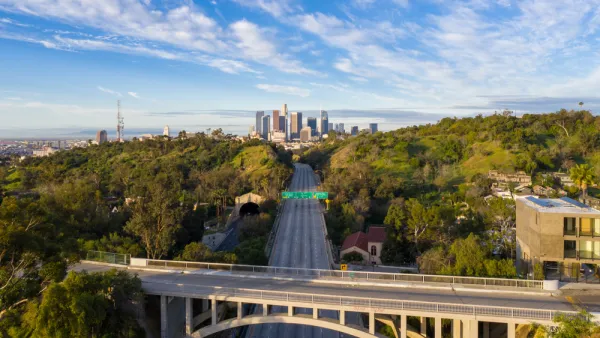
Calls for Environmental Action Increasing as Coronavirus Lingers
We can't go back to the way of life that makes pollution and climate change acceptable, according to multiple articles published on and around Earth Day. It's time for change.
Asthma and Planning
Re-evaluating the role of planning in creating, and reversing, disturbing public health outcomes, like asthma rates among African-Americans in Philadelphia.

Planetizen Federal Action Tracker
A weekly monitor of how Trump’s orders and actions are impacting planners and planning in America.

California plans to bury El Niño’s downpour
If the state plays its cards right, it may be able to store a billion acre-feet of El Niño’s water in aquifers.

Desperate measures: Advocates weigh draining Lake Powell to fill Colorado River
Draining the reservoir could reduce evaporation losses by a couple hundred thousand acre-feet.

Mamdani’s pied-à-terre tax survives legal challenge
A panel of judges found that the plaintiffs failed to demonstrate injury as a result of New York City's implementation of the tax.

Eastern Nebraska is running out of electricity
Data centers and electrification are straining eastern Nebraska’s grid, throttling economic development.

Seattle passes record-breaking transit services expansion
Proposition 1 will double the city’s transit tax to add 95,000 more bus trips and preserve 180,000 bus trips annually.

FREE Course: Walkable City 1: Why Walkability?
After describing his path towards focusing on walkability as the essence of good planning, Jeff Speck marches through his five principal reasons for making more walkable places.
Reinventing Malls: Planning Alchemy—Turning Gray Fields Into Gold
The course focuses on the opportunities and imperatives that shape reinvention of mall sites.

City of Rosemead
Rutgers University, Edward J. Bloustein School of Planning and Public Policy
One Hundred Miles
University of Michigan School for Environment and Sustainability (SEAS)
Hunter College, City University of New York (CUNY)
The Architects Foundation
City of Cambridge
Montrose County
The Pocatello Development Authority