Conventional planning assumes that travellers want to save time, but evidence indicates that they usually prefer to save money. How can planning better reflect these preferences?


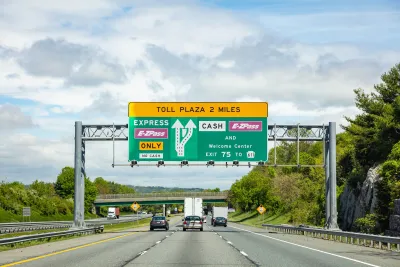
Every time somebody obtains a motor vehicle, they expect governments to provide roads for their use. How much should governments spend and who should pay? Do we prefer an expensive, higher-performance road system for faster driving, or a slower but more economical system that minimizes tax burdens? Many motorists dream of driving a sports car but choose moderate-priced vehicles; it turns out most travellers favor affordability over speed.
How can planning reflect these values? My research indicates that transportation planning often overvalues speed and undervalues other goals — affordability, comfort, equity and even safety — compared with what travellers want. Many of these are technical biases related to how we evaluate transportation system performance and prioritize investments. Let’s investigate.
Travellers' choices reveal priorities
Conventional transportation performance indicators such as roadway level-of-service (LOS), the Travel Time Index and hours of congestion delay assume the goal is to maximize traffic speeds. Yet, when given a choice, most travellers choose to save money rather than time. For example, only 11 percent of travellers on Houston’s Katy Freeway and less than a third on Miami’s I95 pay optional tolls to use uncongested lanes, and many toll roads have gone bankrupt due to lower than expected traffic volumes and revenues. In the 1960s motorists paid the current equivalent of about $1,500 annual road user fees, about three times what they do now, as illustrated below; there is no evidence that voters want higher road user fees to finance roadway expansions. It turns out that motorists want premium performance roadways provided somebody else bears the costs, but if asked to pay directly they choose alternative travel times, modes or destinations.
Per-Vehicle Road Expenditures, Revenues and Subsidies

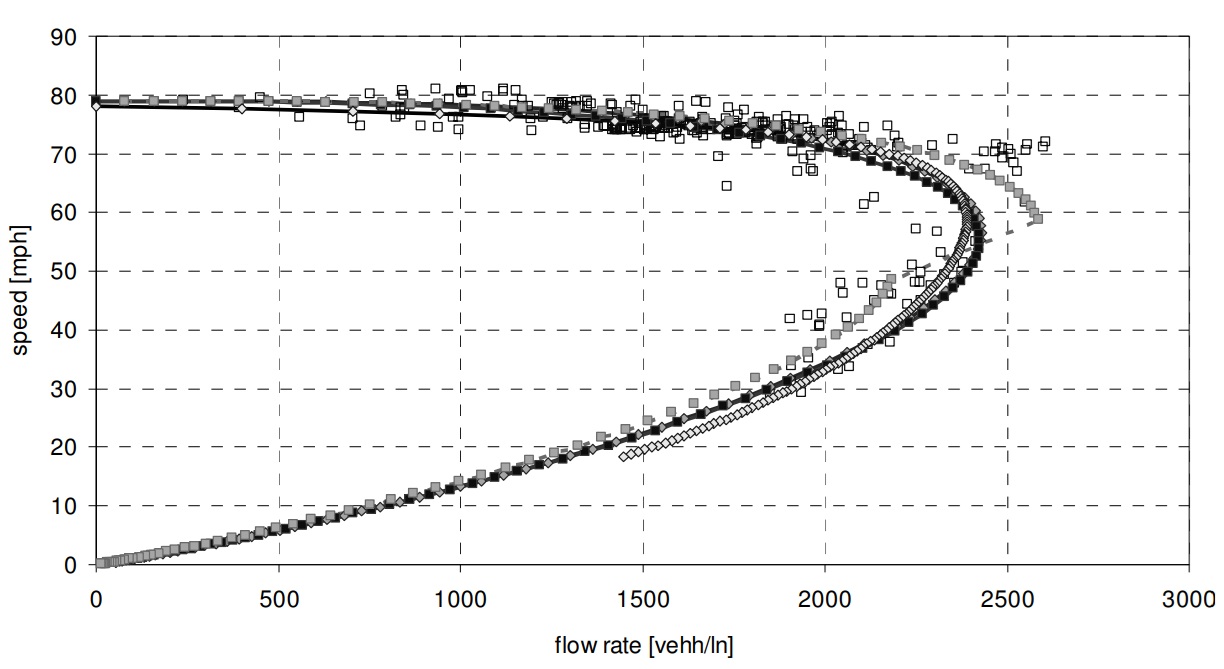
Transportation engineers evaluate roadway performance using “nose cone” graphs such as the one below, which show how flow rates vary by traffic speeds. There are two things to notice. First, under uncongested freeflow conditions with fewer than 1,000 vehicles per lane-hour, traffic averages 75-85 mph, significantly above legal speed limits. Also note that when flows increase to 2,000 vehicles, per lane hour speeds decrease 10-30 percent as traffic becomes congested and unstable.
California State Highway Speed/Volume Curves
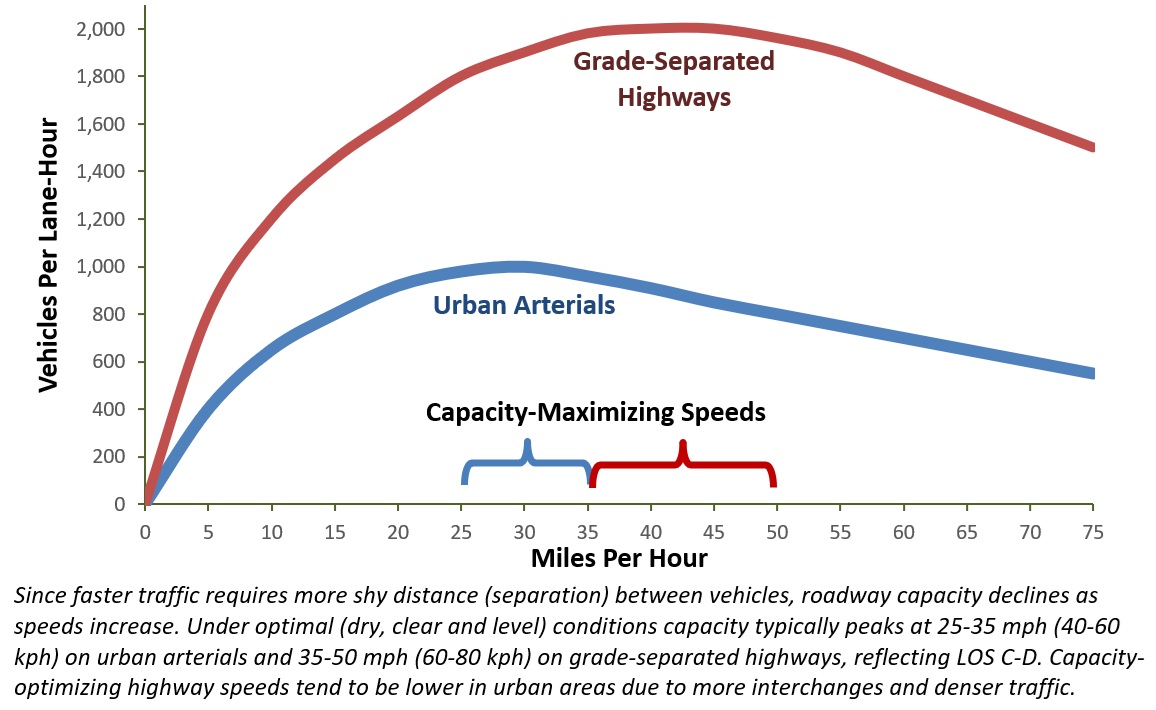
Transportation planners use these graphs to justify roadway expansions so traffic volumes decline to allow higher speeds. My new study, Traffic Speed Versus Roadway Capacity, examines this issue from a different perspective: rather than identifying the traffic flow levels that maximize speed it identifies the speed levels that maximize flow and therefore roadway cost efficiency (maximum vehicles per infrastructure investment dollars.) The graph below shows the nose cone graph rotated counterclockwise. It indicates that roadway capacity and cost efficiency tend to peak at moderate speeds, beyond which flows decline and roadway costs per vehicle trips increase.
Traffic Volumes Versus Speed for Urban Arterials and Highways
Adding traffic lanes to maintain such low flows on busy corridors is expensive, typically costing $10-45 million per mile on urban arterials and $15-65 million per mile on large-city freeways or $1.40 to $2.50 per additional peak-period vehicle-mile. When congested roads are expanded a major portion of the added capacity soon fills with induced vehicle travel, additional vehicle trips that would not otherwise occur. Congestion returns to previous levels with increased volumes which increase downstream congestion, parking subsidy costs and crashes. In addition, wider roads and higher traffic speed degrade walking and bicycling conditions, called the barrier effect.
A basic economic principle is that economic systems are most efficient and fair if the prices consumers pay for goods reflect their marginal production costs unless subsidies are specifically justified. Or, as it is commonly described, consumers should “get what they pay for and pay for what they get.” This prevents governments from spending two dollars for facilities that users only value at one dollar, avoids forcing non-users to subsidize expensive facilities they do not demand, and allows higher value trips to outbid lower value trips for scarce road space. Highway expansion projects that cannot be financed by user fees are economically inefficient — their costs exceed their benefits.
This situation creates a paradox; motorists complain about traffic congestion and demand higher performance roadways provided somebody else bears the costs, but when asked to pay directly for roadway expansions with efficient tolls, demand disappears. Most travellers respond by shifting time, mode or destination. Just as most motorists choose affordable rather than premium vehicles, most motorists want affordable rather than premium roadways.
How to actually fund transportation
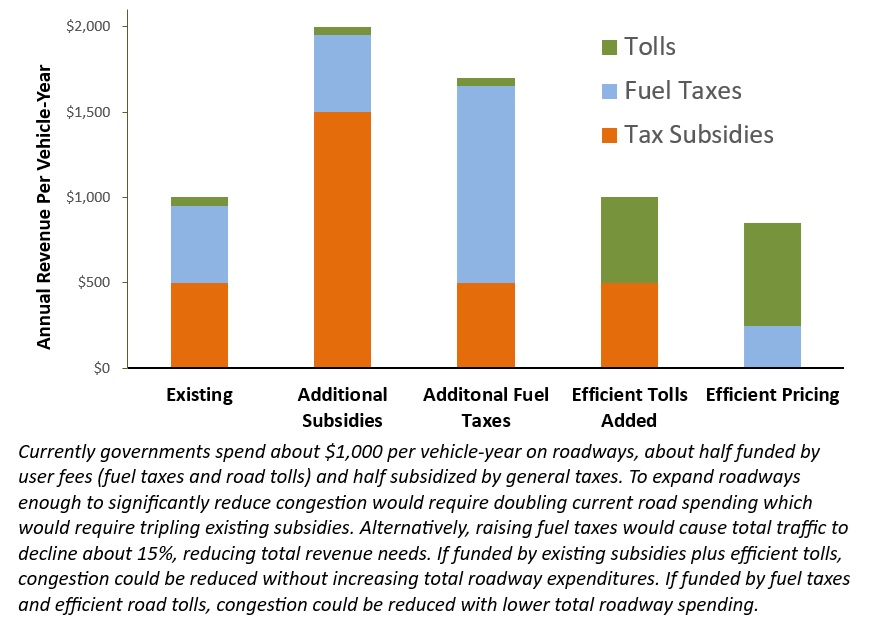
A smarter strategy is to use efficient road pricing as a preventive strategy to reduce congestion on existing roads and minimize total roadway costs. As previously described, governments currently spend about $1,000 per vehicle-year on roads, about half of which is funded by user fees and the rest subsidized by general taxes. At this funding level many urban roads are congested, they operate at LOS C-E. What additional funding is needed to significantly reduce congestion? That depends on how it is generated.
If financed by general tax subsidies, expanding roadways to significantly reduce congestion would require about doubling spending to $2,000 annually per vehicle-year, which is about the current value of what governments spent on roads during the peak highway building period in the 1960s. Financing roadway expansions with increased fuel taxes would give motorists a modest incentive to reduce driving. Federal and state fuel taxes currently total about 51 cents per gallon of gasoline, about 17 percent of current $3.00 per gallon prices, so total fuel prices would increase 17 percent if fuel prices were doubled, and up to 50 percent if fuel taxes were tripled. Assuming a -0.3 long-term fuel price elasticity, this would reduce total driving 5 to 15 percent, providing only modest congestion reductions.
Much larger congestion reductions are possible if transportation improvements are financed by efficient tolls with higher rates under urban-peak conditions, as economists recommend. Revenues should be invested in the most cost-effective improvements, which in urban areas are often improvements to non-auto modes — bicycling, ridesharing, public transit and telework — since they require less space and have lower infrastructure costs per mile than driving. This helps reduce congestion by giving travellers better alternatives to driving, which reduces the toll needed to achieve congestion reduction targets. This combination of road tolls and public transit improvements has proven successful in reducing traffic delays in London, Stockholm, and recently New York where a $9 per day toll reduced vehicle trips 10-20 percent and increased traffic speed 11 percent in the tolled area. Better designed tolling systems that charge per vehicle-mile driving on congested roads could be even more effective. This means that efficient pricing, with roadway costs fully recovered by efficient tolls, can reduce traffic problems and the need to expand roadway, providing large savings, particularly compared with road expansions financed with general tax subsidies.
Efficient pricing improves efficiency in another important but often overlooked way; it allows higher value trips to outbid lower value trips on congested roads. For example, given a choice between an untolled congested road or paying a $10 toll to use an uncongested lane, a typical commuter would usually choose to save money, but once or twice a month might happily pay the toll to save time for an urgent trip. Similarly, a commuter who often uses transit but drives when in a hurry benefits from road tolls that fund transit improvements so their transit trips are better and their driving trips are faster. Unfortunately, these benefits are often overlooked. For example, the Texas Transportation Institute's How to Fund Transportation website only describes road tolls as a way to finance more lanes; it does not mention pricing of existing roadways to prevent congestion and fund space-efficient alternatives.
The graph below compares funding requirements to significantly reduce congestion using different revenue sources. Large general tax subsidies would be required since they give motorists no incentive to reduce urban-peak driving. If funded by doubling fuel taxes traffic would decline about 15 percent, reducing total revenue needs by that amount. If funded by variable road tolls added to existing road subsidies, congestion could be reduced without increasing total roadway expenditures. And, if entirely funded by efficient road pricing, including modest fuel taxes, a basic distance fee and additional tolls for driving under urban-peak conditions, congestion and total roadway costs could be reduced.
Funding Required to Reduce Congestion by Revenue Source
This suggests that freeflow speeds (LOS A-B) are an unrealistic urban roadway planning target because they usually exceed safe and legal limits, reduce roadway efficiency and significantly increase roadway costs. To maintain freeflow speeds during peak periods, cities would need to at least double their current roadway spending, and since motorists currently pay less than half of roadway expenses, fair and efficient pricing would require at least tripling road user fees. In addition, wider roads and higher traffic speeds will increase crash risk (particularly for walkers and bicyclists), traffic noise, pollution emissions and sprawl related costs. More efficient roadway pricing can reduce congestion on existing roads, avoiding the need to expand urban highways. It is preventive medicine for urban traffic ills.
Of course, motorists accustomed to unpriced roads often complain if asked to pay user fees, but their objections are irrational. Unpriced roads are never really free, we simply pay for them indirectly through general taxes. Paying directly directly is more efficient and fair, and by reducing total vehicle travel it reduces other traffic problems including parking congestion, crashes and pollution emissions. Motorists who oppose user fees should stop complaining about traffic congestion because it is the only effective solution, so saying "no" to road pricing is saying "yes" to more traffic delays.
Smart planning
Traffic congestion is inefficient and frustrating, but is just one of many transportation problems and certainly not the largest. For example, it would not be rational to implement a strategy that, for example, reduces congestion costs by 20 percent but increases vehicle costs, roadway costs, or traffic crash costs by 10 percent because those other costs are larger in magnitude. However, a strategy that reduces congestion by 10 percent, but also reduces vehicle, roadway or crash costs by 5 percent is worth far more in total. Smart planning favors such win-win congestion reduction strategies.
What should planners do? It’s time for transportation agencies to reform planning practices to better align with travellers’ priorities. In particular, we should recognize that most people value affordability and infrastructure cost efficiency more than higher traffic speeds. Planning should be less obsessed with traffic speeds and congestion delays. Instead, it should strive to reduce household and public costs by favoring affordable and resource-efficient modes — walking, bicycling, public transit and telework — and provide more affordable housing options in compact, multimodal neighborhoods where residents can drive less, rely more on non-auto modes and spend less money on transportation.

Toward More Comprehensive Understanding of Traffic Congestion
Conventional planning tends to consider traffic congestion asignificant cost and roadway expansion the preferred solution. It evaluates transport system performance based on indicators such as roadway Level of Service (LOS) and peak-period traffic
America's 'roundabout city' is in … Indiana?
Carmel, Indiana has built over 150 roundabouts as part of a broader mobility and development strategy.

How “Walking Audits” Can Improve Neighborhood Mobility
A simple walk through your community can reveal infrastructure gaps and highlight where cities can make streets safer for pedestrians.

Planetizen Federal Action Tracker
A weekly monitor of how Trump’s orders and actions are impacting planners and planning in America.

Colorado’s Largest Data Center Could Rise Next to Homes — Without a Public Hearing
The proposed campus would consume 11 times the power of Denver International Airport; as it has across the country, opposition mounts.

US to reduce Colorado River water deliveries to Mexico
A new Colorado Treaty amendment reduces Mexico’s Colorado River water allocation by 250,000 acre feet.

'This is going to be painful:’ Virginia stares down $1.7 billion funding gap for highway maintenance
The state may address the deficit by shifting $290 million from its construction budget to maintenance projects.

Judges permit Denver to divert 77,000 acre feet from the Colorado River for reservoir expansion
Overuse and climate change have caused the Colorado River’s water levels to plummet.
Amtrak, CN end decades-long dispute with eight-year agreement
The new operating agreement establishes an updated framework for the companies to work together, including processes to resolve disputes.

FREE Course: Walkable City 1: Why Walkability?
After describing his path towards focusing on walkability as the essence of good planning, Jeff Speck marches through his five principal reasons for making more walkable places.
Reinventing Malls: Planning Alchemy—Turning Gray Fields Into Gold
The course focuses on the opportunities and imperatives that shape reinvention of mall sites.

KFH Group Inc.
Greater Baltimore Committee
Eagle County Government
The Architects Foundation
University of Cincinnati Online
The Pocatello Development Authority
The Urban Renewal Agency of the City of Pocatello

