Parking regulations affect our lives and communities in many, often mysterious ways. These impacts are often overlooked, resulting in bad policies. It's time to apply urban planning magic: fewer driveways and better managed public parking.



Parking regulations are like dark matter: they affect nearly every aspect of the urban universe including housing affordability, travel activity, development patterns, fairness and community livability. But these impacts are seldom perceived and often overlooked. Planners are slowly beginning to understand their full effects.
Until recently, parking planning had one goal: motorists’ convenience. It assumed that parking should be as abundant as possible so that motorists can find an unoccupied and generally free space at any destination. But as we’ve learned, that approach is costly and contradicts other community goals.
Considering land, construction and operating expenses, a typical urban parking space carries a total cost of about $1,200 annually. Since there are between two and six spaces per vehicle, this typically totals $3,000 to $5,000 per vehicle. For every dollar a motorist spends on their automobile somebody typically spends about a dollar for its parking. Most of these costs are borne indirectly, resulting in higher taxes, rents and retail prices, plus environmental damages caused by pavement. This is unfair; parking mandates force people who drive less than average to subsidize the parking costs of their higher-mileage neighbors.
Typical Annualized Costs per Parking Space

The inefficiency of parking mandates for single-family homes
Most cities require two off-street parking spaces per single-family home. This is expensive, typically increasing housing costs 10 to 20 percent, particularly for lower-priced housing in areas with high land prices. It is particularly unfair to lower-income, car-lite households that are forced to pay for costly parking facilities they don’t need.
In addition, these regulations often fail to achieve their goal: on most urban residential streets they reduce rather than increase the number of parking spaces available, making motorists worse off overall. Let me explain.
To understand this issue, it is important to make a distinction between total parking supply and functionally available parking supply. In many situations, a major portion of parking spaces are unavailable to most motorists. Public spaces can be used by virtually any motorists but private spaces are only available to designated users: residents and their visitors, employees and customers.
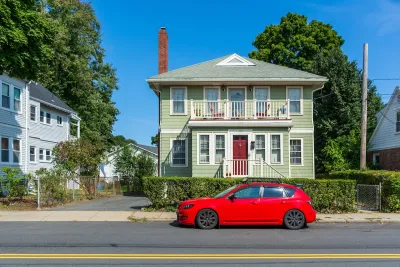
Since a typical driveway displaces one on-street parking space, homes with off-street parking have fewer public parking spaces than those without, as detailed here and illustrated below.
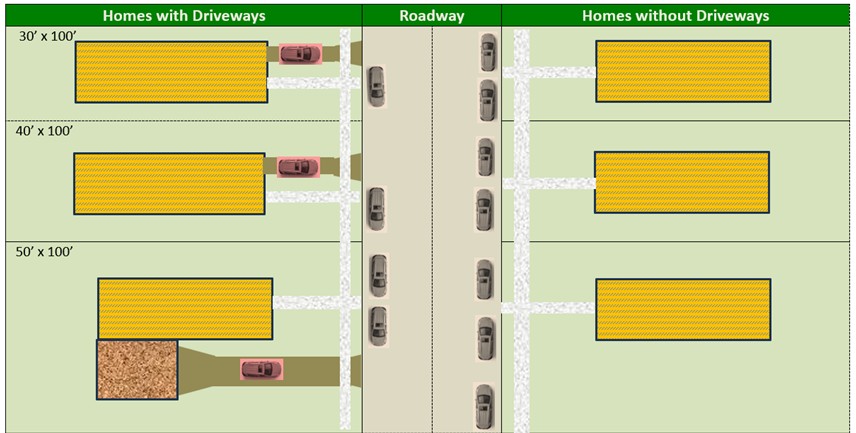
Although driveways can often accommodate multiple vehicles, in practice they seldom do; garages are often used for storage or as workshops. In my urban neighborhood, most single-family home driveways accommodate just one vehicle, and are unoccupied 20-40 percent of the time. As a result, public on-street parking can accommodate far more vehicles than the same number of private off-street spaces.
Public parking spaces are more efficient because they can accommodate diverse users, for example delivery vehicles in the morning, service vehicles during the day, visitors in the evening and residents overnight. A home’s parking demands will fluctuate over time as the number of vehicles owned by occupants varies; a pool of public on-street spaces accommodates those changes much better than a fixed supply of private off-street spaces. As a result, most motorist are are worse off if their neighbors have off-street parking since that reduces the number of spaces available for their use.
For example, if your block has 100 homes with 40-foot average street frontages, without driveways it would have 200 public parking spaces, but if each house has a driveway, there are only 100 public spaces available. As a result, it is much easier for delivery and service vehicles and guests to find an available space on streets without off-street parking requirements.
My research indicates that in a typical urban neighborhood with less than 50-foot house frontages, off-street parking mandates reduce available parking supply, making motorists worse off overall.
Increasing harmful pavement
By increasing pavement area, off-street parking requirements also exacerbate other problems, including increased stormwater management costs, heat island effects, greenspace displacement and urban ugliness.
The figure below compares impervious surface area for typical urban residential parcels with and without driveways. Driveways increase impervious surface area by 25 to 60 percent. Driveways also cause risks and delay to pedestrians on sidewalks, particularly if a driveway is inclined or has poor sightlines. One of the most effective ways of improving neighborhood walkability is to eliminate off-street parking minimums.
Impervious Area Per Residential Parcel With and Without Driveways
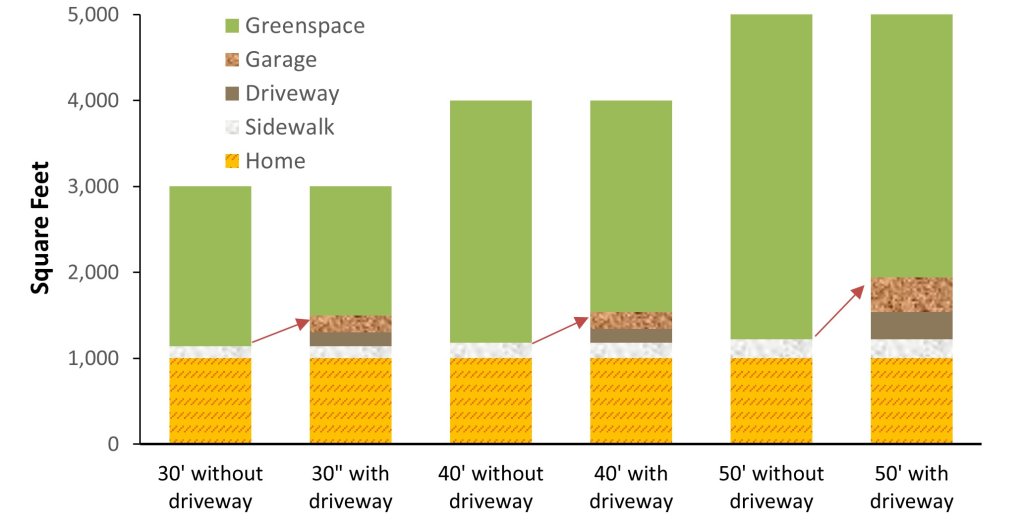
This analysis indicates that in most urban areas, motorists and residents are better off overall with efficiently-managed on-street parking than requiring off-street parking that displaces curb parking, imposes tens of thousands of dollars on property owners, increases pavement area and reduces walkability.
Parking management to the rescue!
This research indicates that efficient parking management provides significantly larger savings and benefits than previously recognized. The Parking Reform Network is leading efforts to make parking planning more efficient and equitable. Cost-effective transportation and parking management strategies can typically halve the number of spaces needed to serve motorists’ demands. The first step is to eliminate parking minimums so that property owners save money when they reduce parking supply.
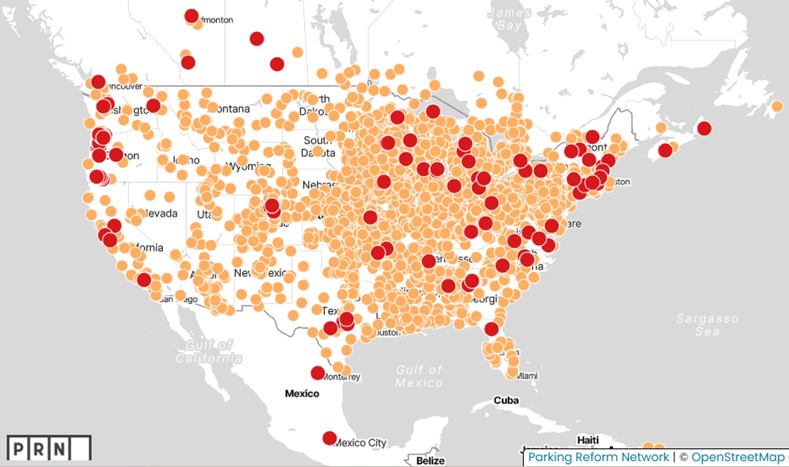
Eliminating parking minimums does not eliminate parking, it simply allows property owners to decide how many parking spaces to provide based on their actual needs, giving property owners incentives to manage parking efficiently. This benefits everybody, including motorists.
Examples of Residential Parking Management Strategies
- Eliminate parking minimums so households are no longer required to pay for costly parking facilities they don’t need.
- Share parking facilities rather than assigning spaces to individual users.
- Efficiently manage public on-street parking with regulations and pricing so they are available to priority users.
- Price parking efficiently.
- Manage spillover; give motorists information on off-site parking options and improve pedestrian connections.
- Improve and encourage non-auto travel.
- Improve and encourage carsharing.
Planners can share this good news: communities that replace parking minimums with better management can be more affordable, efficient, fair and attractive. That is urban planning magic!

ITDP's New On-Street Parking Pricing Guidebook
This report explores strategies for efficient and equitable parking management with an emphasis on pricing. These strategies enable cities to reallocate space for bus lanes, bicycle lanes, wider sidewalks, and pickup zones, and generate revenue.
Opinion: Chicago Needs an Office of Parking Management
The city of Chicago needs a local agency empowered to planning, studying, or managing parking, according to a recent opinion piece published by Streetsblog Chicago.

Hong Kong Parking Plan Denounced as 'Wasteful'
Hong Kong's leaders want to build more parking for the growing number of private vehicles, but transportation experts suggest parking management could be a faster and more affordable solution.

The state-sanctioned urbicide of Austin
People don’t kill cities. Freeways do.

US to reduce Colorado River water deliveries to Mexico
A new Colorado Treaty amendment reduces Mexico’s Colorado River water allocation by 250,000 acre feet.

New Jersey’s second-largest city bans standalone data centers
Jersey City will continue to allow co-location facilities, such as those meant for research institutions that store their own data.

Amtrak not solely to blame for New Jersey commuter rail's unreliability, report finds
A new study from the Garden State Initiative found that NJ Transit’s budget grew 20% across a 4 year period, but reliability declined significantly over the same period.

EPA erases limits on planet-warming pollution from power plants
Under Monday’s plan, power plants would still have some limits on how much mercury, arsenic and other contaminants they can emit.

Phoenix announces new on-demand transit service, more frequent RAPID buses
Both new services will launch in October, and are part of Phoenix's Project Effective Access Solutions for Easing Congestion.

FREE Course: Walkable City 1: Why Walkability?
After describing his path towards focusing on walkability as the essence of good planning, Jeff Speck marches through his five principal reasons for making more walkable places.
Reinventing Malls: Planning Alchemy—Turning Gray Fields Into Gold
The course focuses on the opportunities and imperatives that shape reinvention of mall sites.

Eagle County Government
Harvard University Graduate School of Design
Nashville Planning Department
The Architects Foundation
University of Cincinnati Online
The Pocatello Development Authority
The Urban Renewal Agency of the City of Pocatello
Journal of the American Planning Association

