It's 'back to the future' for Atlanta's $98 million investment that opened Dec. 30, although these will be modern, not vintage, streetcars that operate on a small loop. Streetcars last operated here in 1949. Mayor Reed intends to lengthen the route.


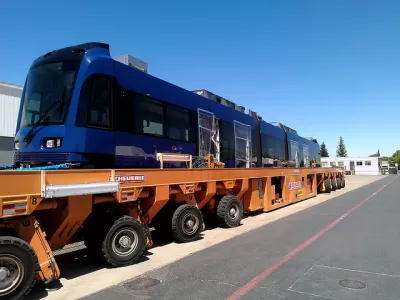
"Although the electric streetcars, condemned by some as a $98 million gimmick, will not relieve Atlanta’s traffic woes as they glide across nearly three miles of track, the system is part of a broader strategy that supporters contend will help remake a city long regarded as something less than an archetype of urban design," writes Alan Blinder of the Atlanta bureau of The New York Times.
Take a test-ride on the streetcar:
For photos from the first day's operation of the long awaited streetcar, see Kimberly Turner's Atlanta Curbed article on the festivities.
Advocates consider the streetcar, almost 50 percent funded by a TIGER grant, to be an essential part of the city's urban future embedded in its past.
“These are not projects for right now,” said Keith T. Parker, the chief executive of the Metropolitan Atlanta Rapid Transit Authority (MARTA). “These are projects for the future, and when you look around, the cities who we’re competing with around this nation and around the world, they’ve made investments in public transportation.”
You won't find Atlanta Streetcar on MARTA's website. It "is a collaborative effort involving numerous individuals and agencies," including MARTA.
The test for the streetcar may be for it to live up to its historic reputation. Speaking of the streetcars of the early twentieth century, Clifford M. Kuhn, an associate professor of history at Georgia State University, said:
“They were hugely significant in the physical growth of Atlanta,” said Kuhn. “They were widely used. The mayor of Atlanta in the early 20th century would ride to work in the streetcar.”
However the limited route misses key destinations, notes Blinder.
But the existing network does not venture near Piedmont Park or Buckhead, Atlanta’s premier retail district. The historic Fox Theater is not along the route, nor is the High Museum of Art. And the streetcar does not reach the Georgia Institute of Technology or the Atlanta University Center, although there is a stop at Georgia State University, which had a fall semester enrollment of more than 32,000 students.
Increasing the streetcar's ridership may be dependent on lengthening the route as well as reducing wait times, which Mayor Kasim Reed said he intends to do. But the most important goal was to open the much-delayed project.
The first thing that we had to do, really, was to get the streetcar up and running because the delays were shaking the confidence in the project, and we needed to put that to bed,” said Mr. Reed, who described Tuesday as a “historic” day in the city.
Indeed, the streetcar was included in Atlanta Curb's "Atlanta's Year in Debacles, Fiascos and Controversies." Kimberly Turner title's her story under "Biggest Tease."
Atlanta's shiny new streetcar will finally carry its first passengers tomorrow, but what a long road it's been (technically only a 2.7-mile road but still…). We have lost count of the alleged launch dates offered since construction began: mid 2013, spring 2014, late spring 2014, summer 2014, fall 2014, "by the end of 2014."...
Now the big question according to WABE, Atlanta's NPR station, is, "Will Residents Use The New Atlanta Streetcar?"
FULL STORY: Atlanta Hopes a Three-Mile Streetcar Route Will Help Foster a New Urban Image

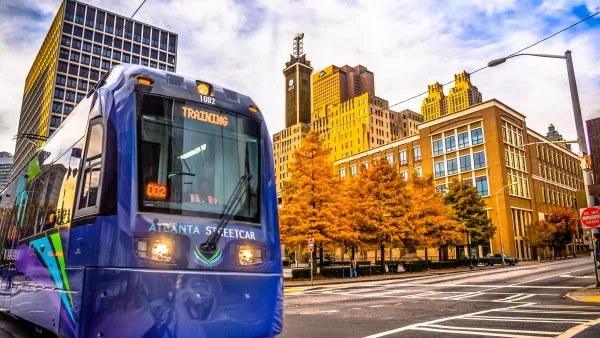
State Threatens Shutdown of Atlanta Streetcar
The commissioner of the Georgia Department of Transportation warned Atlanta Mayor Kasim Reed and MARTA CEO Keith Parker that unless corrective actions are not taken in many areas, e.g., maintenance, safety, he will shut down streetcar service.
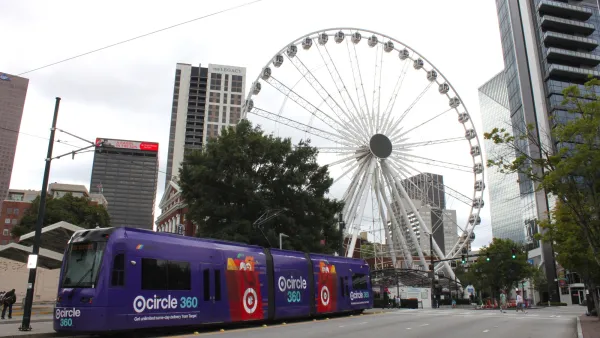
MARTA Streetcar Returns February 3
Streetcar service in Atlanta was suspended for five months for repairs and upgrades.
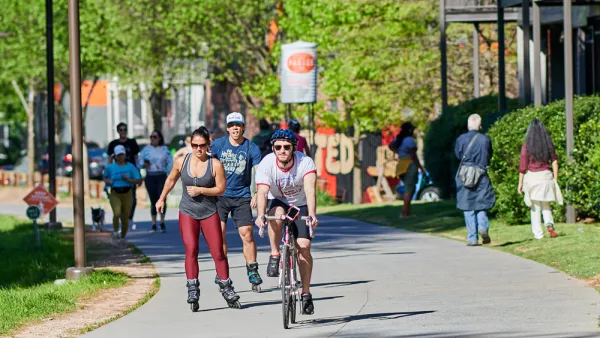
What Should Transit on the BeltLine Look Like?
Supporters of a proposed streetcar extension argue that Atlanta’s popular BeltLine corridor was always meant to include transit, making it more than just a recreational area.

Planetizen Federal Action Tracker
A weekly monitor of how Trump’s orders and actions are impacting planners and planning in America.

The state-sanctioned urbicide of Austin
People don’t kill cities. Freeways do.

US to reduce Colorado River water deliveries to Mexico
A new Colorado Treaty amendment reduces Mexico’s Colorado River water allocation by 250,000 acre feet.

5 New England states march closer to 800 megawatt wind energy project
Securing federal approval for the project may be complicated under the Trump administration, which has historically been hostile towards domestic wind power.

Baltimore to break ground on $50 million Transit Priority Project
The project will bring faster bus trips, safer streets and better bike connections to Baltimore.

Airbnb launches $250 million 'last-dollar financing' housing accelerator, makes first investment in Austin
The company will put $6.4 million towards affordable housing development in Texas’ capital.

FREE Course: Walkable City 1: Why Walkability?
After describing his path towards focusing on walkability as the essence of good planning, Jeff Speck marches through his five principal reasons for making more walkable places.
Reinventing Malls: Planning Alchemy—Turning Gray Fields Into Gold
The course focuses on the opportunities and imperatives that shape reinvention of mall sites.

Eagle County Government
Harvard University Graduate School of Design
Nashville Planning Department
The Architects Foundation
University of Cincinnati Online
The Pocatello Development Authority
The Urban Renewal Agency of the City of Pocatello
Journal of the American Planning Association