Privatization
Does Privatizing Water Systems Make Sense?
Private financing of water systems goes at least as far back as ancient Rome. But as the number of people served by private water companies grows, some cities that have tasted privatization have found it lacking.
Why Architects and Planners Need to Become Better Politicians
Well designed environments assist our economy, wellbeing and happiness, says Sarah Wigglesworth. Yet money equals power in controlling the shape of built environment. She asserts that designers must act as leaders rather than slaves to their clients.
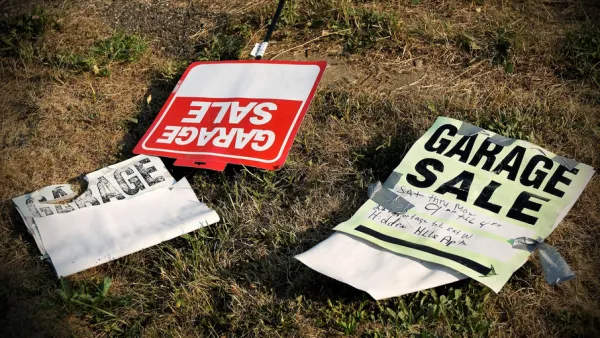
Detroit Plans Massive Garage Sale
The Detroit Zoo's 'healthy, breeding female giraffe'? A classic Ford XD Cobra prototype? Belle Isle? Mark Stryker and John Gallagher look at some of the city-owned assets that could be sold to help pay off the city's monstrous debt.
A Proposal for Reducing New York's Open Space Inequity
With park finances increasingly determined by private fundraising efforts, New York's park system is beginning to reflect the city's growing inequality. Could a Neighborhood Parks Alliance help rebalance the city's park dichotomy?
Cities Gain a Brain; But Will They Lose Their Souls?
In the quest to improve efficiency and effectiveness, "smart" technologies are helping cities become more intelligent machines. But a growing chorus fears the side effects of increased privatization, surveillance, and technological sophistication.
Could the Bloom be off D.C.'s Boom?
Annie Lowrey looks at how the taxpayer funded expansion of private contracting for the federal government turned D.C. from "national embarrassment" to creative class hot spot, and why those boom days may be coming to an end.
Chicago for Sale
Mick Dumke dives deep on Mayor Rahm Emanuel's ambitious plans to "exchange public space and public rights for private cash." Has the city learned anything from the parking meter debacle?
Why Public Spaces Are Crucial for 'the Future of the Human Race'
Jay Walljasper chronicles the decline of lively public spaces in the era of "rampant traffic, proliferating privatization, heightened security...and the internet," and human kind's existential need for protecting and expanding the public realm.
Pittsburgh Wants to Sell Out
Under new legislation introduced this week in City Council, naming rights for Pittsburgh's public buildings and advertising on city vehicles and employee uniforms will be sold to the highest bidder in an effort to monetize the city's resources.
The Completely Privatized City
Sandy Springs, Georgia has taken the libertarian tip and privatized almost every city service - including planning. So does it work?
Italian Bullet Trains Open to Private Competitor
Gaia Pianigiani discusses the recent opening of a new, luxury high-speed rail line in Italy – Europe's first private competitor to domestic, state-run HSR.
Cities Reach Out to Private Sector to Solve Fiscal Challenges
Kirk Victor examines the new and risky roads many cities are taking to get immediate access to capital in order to finance their fiscal challenges.
New Jersey Parks Get Partially Privatized
A new plan from Governor Christie involves the state retaining control over the parks but contract with non-profit and business partners for services.
Republicans Opening the Door to Public/Private Partnerships
Senator Mark Kirk presented details yesterday about his plan to lease public transportation assets to private companies or partner with them to expand transit.
Bill Proposes Privatization of Northeast Rail Corridor
House Transportation Committee Chairman John Mica has proposed a bill to privatize Northeast Corridor rail operations. This post from Pedestrian Observations looks at what such a plan would mean.
Protests in Tokyo over Privatizing Public Space
Miyashita Park in Tokyo is an historic site with a history of homeless encampments. Officials plan to turn the park into a skateboard park, with naming rights purchased by Nike.
Park Funding Problems? Privatize
More parks in the U.S. should fight funding issues through privatization, writes John Stossel.
Who's Driving This Public Transit System?
Virtually every modern economy is mixed: governments produce some goods and services and private companies produce others. Governments generally provide those goods and services that are either considered essential and should be available to everybody regardless of ability to pay, or that require strategic coordination, including police protection, basic education, transportation infrastructure, parks, and public health services. Transportation facilities and services are among these basic government functions.
Making the Transit-Land Value Connection
When the link between transit operators and real estate developers was severed in the early 20th century, transit became both unprofitable and unresponsive to market demand, and land value-lowering MTA cuts are just one example, says Stephen Smith.
Private Buses Make a Comeback in NYC
Recent MTA budget cuts have forced New York City to axe a few of its bus routes, but they've had the effect of spurring a new wave of private bus initiatives.

FREE Course: Walkable City 1: Why Walkability?
After describing his path towards focusing on walkability as the essence of good planning, Jeff Speck marches through his five principal reasons for making more walkable places.
Reinventing Malls: Planning Alchemy—Turning Gray Fields Into Gold
The course focuses on the opportunities and imperatives that shape reinvention of mall sites.

City of Thousand Oaks
City of Wisconsin Rapids
Harvard University Graduate School of Design
The Architects Foundation
University of Cincinnati Online
The Pocatello Development Authority
The Urban Renewal Agency of the City of Pocatello