The county of San Diego wants sprawling suburban developments to buy carbon offsets, billing the idea as a fix to the region's housing affordability crisis.


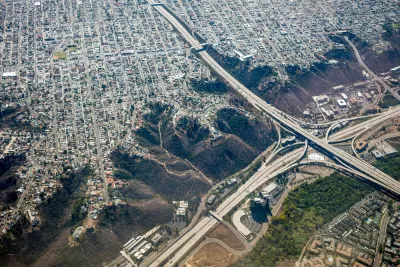
The San Diego County Board of Supervisors is considering a collection of developments that would put a serious dent in its climate action plan.
"Citing the state’s desperate need for housing, it’s poised to adopt a potentially precedent-setting strategy that would allow developers to buy millions of dollars in carbon offsets in exchange for building projects that dramatically increase the number of cars on the road," reports Joshua Emerson Smith.
The Board of Supervisors could fast track seven new suburban housing developments, spread around the county and totaling 10,000 housing units. The new developments "would also generate enough greenhouse gases to cancel out all of county’s envisioned efforts, under its climate action plan, to reign in transportation emissions by mid-century."
To counteract those carbon emissions, the county will allow the developers "to purchase offsets to account for roughly 77 percent of all the potential greenhouse gases attributed to the nearly 10,000 new units. The rest of the emissions would be addressed through onsite efforts, such as solar panels and electric car charging ports."
The plan is controversial, and the Sierra Club and other environmental organizations have filed a lawsuit to challenge the use of offsets. More details on the political debate, the development proposals, and the potential precedent for the rest of the state are included in the article.
FULL STORY: Should housing developers be allowed to pay their way out of climate pollution?


How Cities Can Lead the Way in Reducing Transportation Emissions
Decisions made at the local level can have a significant impact on emissions in the transportation sector.

Seattle Mayor Calls for ‘Low-Pollution Neighborhoods’
An executive order signed last week consolidates actions the city plans to take to reduce greenhouse gas emissions.

How Urban Sprawl Came To Dominate U.S. Cities—And How To Change That
The auto-centric development patterns of American cities are a result of decades of misguided, but reversible, policy decisions.

Planetizen Federal Action Tracker
A weekly monitor of how Trump’s orders and actions are impacting planners and planning in America.

The state-sanctioned urbicide of Austin
People don’t kill cities. Freeways do.

US to reduce Colorado River water deliveries to Mexico
A new Colorado Treaty amendment reduces Mexico’s Colorado River water allocation by 250,000 acre feet.

Mamdani overhauls NYC's Vision Zero plan with 100 new policy goals
The overhaul aims to reduce traffic deaths and make streets safer for pedestrians, cyclists and drivers through lower speed limits, new safety infrastructure and more.

Amtrak not solely to blame for New Jersey commuter rail's unreliability, report finds
A new study from the Garden State Initiative found that NJ Transit’s budget grew 20% across a 4 year period, but reliability declined significantly over the same period.

EPA erases limits on planet-warming pollution from power plants
Under Monday’s plan, power plants would still have some limits on how much mercury, arsenic and other contaminants they can emit.

FREE Course: Walkable City 1: Why Walkability?
After describing his path towards focusing on walkability as the essence of good planning, Jeff Speck marches through his five principal reasons for making more walkable places.
Reinventing Malls: Planning Alchemy—Turning Gray Fields Into Gold
The course focuses on the opportunities and imperatives that shape reinvention of mall sites.

Eagle County Government
Harvard University Graduate School of Design
Nashville Planning Department
The Architects Foundation
University of Cincinnati Online
The Pocatello Development Authority
The Urban Renewal Agency of the City of Pocatello
Journal of the American Planning Association