Allison Arieff writes a passionate plea for Americans to ditch the car and reconnect with pedestrian experiences. There's even a car company helping pave the way for a new approach to streets.



"Most of us pass through the places where we live, work and play not on two feet or two wheels but in cars," writes Arieff. "We are disconnected from our streets — and so we don’t care about them."
Arieff's eloquence in stating the problem is unparalleled, but the attention quickly turns to solutions. A car company, Ford, provides the perhaps surprising source of inspiration for the article. According to Arieff, "Ford, like many other automobile manufacturers, sees the writing on the wall….Ford has been steadily diversifying from a car company to a 'mobility company.'"
The company has proven itself by funding the National Street Service, which has piloted in Boise, Philadelphia, San Antonio, San Francisco, and Pontiac. "Over the course of 10 weeks, participants first observe and learn about their favorite (and least favorite) streets and then brainstorm ideas for low-cost interventions to make those streets better," explains Arieff. "Volunteers and project leaders then collaborate on a larger-scale effort to carry out some of those ideas and engage their respective communities."
Read the full story: Let’s Reconnect With Our Streets


Oklahoma House Approves Protections for Drivers Who Hit Protestors
A heated debate and a party line vote in Oklahoma.
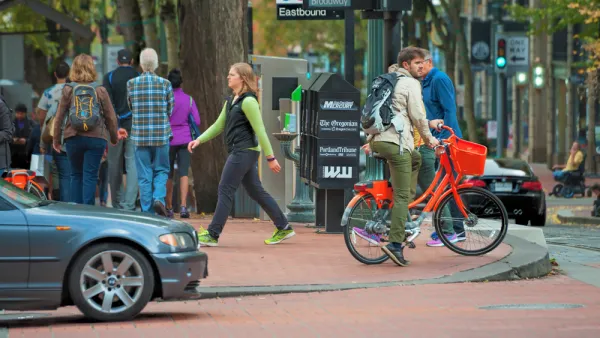
Roadways for People: The Necessity of Collaboration
Breaking down planning silos to ensure transportation options in a car-oriented world.
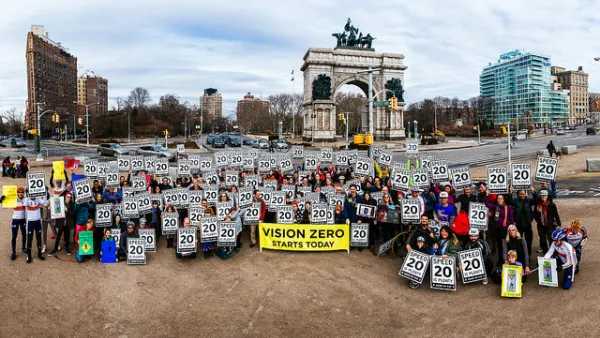
Zero Traffic Deaths Isn't as Far Fetched as It Sounds
Even supporters of Vision Zero—a goal to eliminate traffic fatalities from roadways adopted by cities and states all over the United States—doubt that such lofty ambitions are possible. But there are plenty of reasons to believe in the cause.

Planetizen Federal Action Tracker
A weekly monitor of how Trump’s orders and actions are impacting planners and planning in America.

California plans to bury El Niño’s downpour
If the state plays its cards right, it may be able to store a billion acre-feet of El Niño’s water in aquifers.

Chicago breaks ground on $3 billion megadevelopment
The new neighborhood, titled Foundry Park, will one day host 3,700 residences.

California High-Speed Rail Authority CEO resigns after $600,000 scandal
Under Ian Choudri, the authority used taxpayer dollars to fund first class flights and trips to nightclubs.

Want to study the Missouri River? Soon, you may need unanimous approval from 10 states
Legislation would require 10 governors’ permission to study or build projects moving water outside the basin.

Desperate measures: Advocates weigh draining Lake Powell to fill Colorado River
Draining the reservoir could reduce evaporation losses by a couple hundred thousand acre-feet.

FREE Course: Walkable City 1: Why Walkability?
After describing his path towards focusing on walkability as the essence of good planning, Jeff Speck marches through his five principal reasons for making more walkable places.
Reinventing Malls: Planning Alchemy—Turning Gray Fields Into Gold
The course focuses on the opportunities and imperatives that shape reinvention of mall sites.

City of Rosemead
Rutgers University, Edward J. Bloustein School of Planning and Public Policy
One Hundred Miles
Hunter College, City University of New York (CUNY)
The Architects Foundation
University of Cincinnati Online
City of Cambridge
Montrose County
The Pocatello Development Authority