To reach goals in reducing emissions, Gates's group is looking to invest in technology that can provide energy in efficient ways by supplying clean power when the sun isn't shining and the wind isn't blowing.


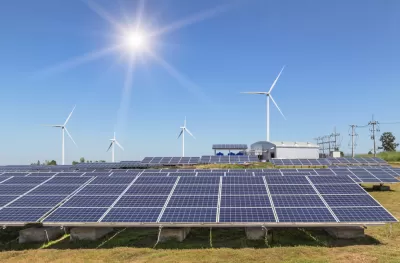
Bill Gates’s clean energy investment group, Breakthrough Energy Ventures (BEV), founded with support from other billionaires like Richard Branson and Jack Ma, is targeting energy storage. This socially mind group sees energy storage as a source of innovation that could bring clean energy to more people around the world. "Energy storage can overcome the biggest limitation of modern renewable power: Solar panels and wind turbines can only generate energy when the sun is out or the wind is blowing," Akshat Rathi reports for Quartz.
These companies intend to move beyond even the recent innovations in lithium batteries."…the first two startups that BEV will be investing in: Form Energy and Quidnet Energy. Both companies are developing new technologies to store energy, but taking completely different approaches to achieve that goal," Rathi reports.
Form Energy is investigating ways to improve batteries so they run for longer periods of time more cost effectively. "Experts predict that lithium-ion battery costs will bottom out at about $100/kWh. The solution to store energy for weeks and months at a time then would be to develop batteries that can cost less than $10/kWh," Rathi reports. Form says they have two candidates to try to move beyond lithium batteries. "One of the candidate chemistries, Chiang confirmed, is a “sulfur-flow battery,” which he wrote about in some detail in the journal, Joule, in October 2017."
Quidnet, meanwhile, is looking at ways to store energy in water that moves turbines, an old practice with a new twist. "… but without the need for rivers or dams. Instead, it uses excess electricity to pump water into the underground shale rock found in new wells dug for the purpose or in abandoned oil-and-gas wells," Rathi writes.
Read the full story: To hit climate goals, Bill Gates and his billionaire friends are betting on energy storage


Expanded Solar Capacity Means Supply Exceeds Demand for Solar in California
California is setting records for the amount of solar energy it can’t use, but this cushion might be a good thing: it means the state won’t need to depend as heavily on fossil fuels as a stopgap.
Could the Humble Heat Pump Be a Decarbonization Hero?
Buildings are responsible for a little less than half of greenhouse gas emissions in the U.S. Break this figure down further and you'll find that building heating accounts for about a fifth of all U.S. emissions.

Court unfreezes $20B in federal climate grants
A U.S. Court of Appeals ruled that the Trump administration potentially violated the Inflation Reduction Act by attempting to claw back grants awarded under the Greenhouse Gas Reduction Fund program.

Planetizen Federal Action Tracker
A weekly monitor of how Trump’s orders and actions are impacting planners and planning in America.

California plans to bury El Niño’s downpour
If the state plays its cards right, it may be able to store a billion acre-feet of El Niño’s water in aquifers.

Chicago breaks ground on $3 billion megadevelopment
The new neighborhood, titled Foundry Park, will one day host 3,700 residences.

Satanic place names
From streams and lakes to valleys and canyons, I mapped more than 1,000 places named after the Devil.

California High-Speed Rail Authority CEO resigns after $600,000 scandal
Under Ian Choudri, the authority used taxpayer dollars to fund first class flights and trips to nightclubs.

Want to study the Missouri River? Soon, you may need unanimous approval from 10 states
Legislation would require 10 governors’ permission to study or build projects moving water outside the basin.

FREE Course: Walkable City 1: Why Walkability?
After describing his path towards focusing on walkability as the essence of good planning, Jeff Speck marches through his five principal reasons for making more walkable places.
Reinventing Malls: Planning Alchemy—Turning Gray Fields Into Gold
The course focuses on the opportunities and imperatives that shape reinvention of mall sites.

City of Rosemead
Rutgers University, Edward J. Bloustein School of Planning and Public Policy
One Hundred Miles
Hunter College, City University of New York (CUNY)
The Architects Foundation
University of Cincinnati Online
City of Cambridge
Montrose County
The Pocatello Development Authority