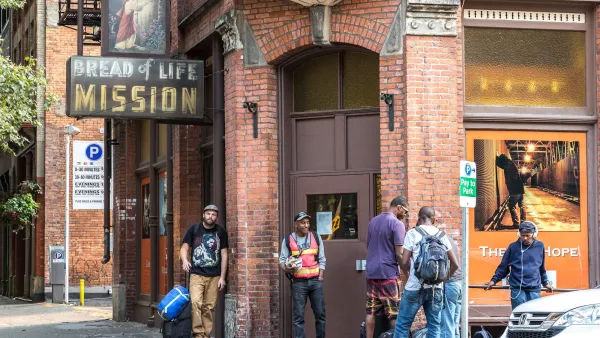
Homeless villages aren't hotbeds of crime, according to recent analysis. Rather, they can be part of a "crime prevention ecosystem."



"[A] Guardian investigation in two US cities where such highly organized homeless villages are common, Seattle and Portland, found that their presence was not generally accompanied by a rise in crime in their neighborhoods," reports Thacher Schmid. "In fact, crime was likelier to go down."
The Guardian analysis backs up statements by researchers from George Washington University and the Center on Juvenile and Criminal Justice, as quoted in the article.
That being said, "[t]here is a distinction between these villages and the ad hoc, curbside agglomerations of tents and tarps that have come to symbolize the surging homelessness crisis in many cities across the western US," according to Schmid. Homeless villages are sanctioned, to varying extents, "are largely self-governing, and have defined boundaries and codes of conduct."
It's also worth noting that the Guardian used public crime statistic dashboards (Seattle and Portland) to conduct the analysis, exhibiting yet another productive application for municipal data sharing platforms.
FULL STORY: No link between homeless villages and crime rates, Guardian review suggests


Tiny Home Village to Close Amid Controversy in Seattle
The situation at the tiny home village in the Seattle neighborhood of Northlake has been deteriorating since April.
Seattle mayor pledges to build 500 shelter units by June
The Seattle Times editorial board expresses cautious optimism about the mayor's ambitious supportive housing plan.

Tiny House Villages for Addressing Homelessness: An Interview with Yetimoni Kpeebi
One researcher's perspective on the potential of tiny homes and owner-built housing as one tool to fight the housing crisis.

The state-sanctioned urbicide of Austin
People don’t kill cities. Freeways do.

US to reduce Colorado River water deliveries to Mexico
A new Colorado Treaty amendment reduces Mexico’s Colorado River water allocation by 250,000 acre feet.

New Jersey’s second-largest city bans standalone data centers
Jersey City will continue to allow co-location facilities, such as those meant for research institutions that store their own data.

Amtrak not solely to blame for New Jersey commuter rail's unreliability, report finds
A new study from the Garden State Initiative found that NJ Transit’s budget grew 20% across a 4 year period, but reliability declined significantly over the same period.

EPA erases limits on planet-warming pollution from power plants
Under Monday’s plan, power plants would still have some limits on how much mercury, arsenic and other contaminants they can emit.

Phoenix announces new on-demand transit service, more frequent RAPID buses
Both new services will launch in October, and are part of Phoenix's Project Effective Access Solutions for Easing Congestion.

FREE Course: Walkable City 1: Why Walkability?
After describing his path towards focusing on walkability as the essence of good planning, Jeff Speck marches through his five principal reasons for making more walkable places.
Reinventing Malls: Planning Alchemy—Turning Gray Fields Into Gold
The course focuses on the opportunities and imperatives that shape reinvention of mall sites.


Eagle County Government
Harvard University Graduate School of Design
Nashville Planning Department
The Architects Foundation
University of Cincinnati Online
The Pocatello Development Authority
The Urban Renewal Agency of the City of Pocatello
Journal of the American Planning Association