From clean drinking supply to sinking infrastructure, California has a lot to worry about when it comes to water. Two upcoming bonds could make a dent in the work ahead.


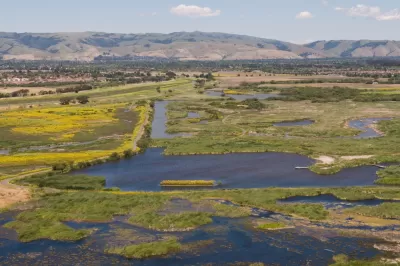
California voters will soon decide whether to fund two water bonds for a total of $13 billion. The Planning Report examines the complementary proposals—one in June and one in November—in an interview with Jerry Meral, a veteran of natural resource management and a proponent of the November bond.
Up first on the June ballot, Proposition 68 would spread $4 billion among parks, trails, and land conservation, as well as water recycling. More money specifically for water infrastructure would come from the $8.9 billion Water Supply and Water Quality bond scheduled for the November ballot. That measure is expansive, covering 100 different types of water projects, Meral says.. Some of its major funding categories include:
- Safe drinking water and wastewater disposal ("a big priority in disadvantaged communities," Meral notes.)
- Wastewater recycling, water conservation, and watershed restoration.
- Implementation of California's Sustainable Groundwater Management Act—a landmark bill meant to help the state replenish the copious amounts of water it draws from underground every year.
- Repair of the Oroville Dam, whose failure in 2017 forced the evacuation of 188,000 people, and of the sinking Friant-Kern Canal, which supplies key farmland areas.
- Restoring the polluted, shrinking Salton Sea. "I daresay the Salton Sea is the single greatest threat to air quality in the United States," Meral says, as the exposed seabed could "blow dust of biblical proportions" all over the state. The two bonds together cover the funding needed for the state's restoration plan.
Meral also talks about California's reliance on bond measures to fund major infrastructure investments, and the willingness of voters to pay for them all. It's not an ideal long-term strategy, he stresses, but for the moment, it could bode well for water in the state—especially since the need for funding is "substantially greater" than the upcoming bond measures combined.
FULL STORY: November Water Bond Promises $8.9 Billion Towards Securing California’s Future

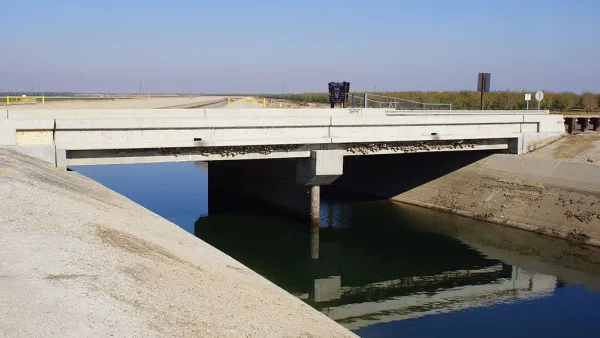
Voters to Decide on Repair of Vital Aqueduct for San Joaquin Valley
California voters in November will have the opportunity to help repair the Friant-Kern Canal, damaged by subsidence, as well as invest in watershed conservation programs, by passing a citizen-initiated $8.9 billion general obligation bond measure.
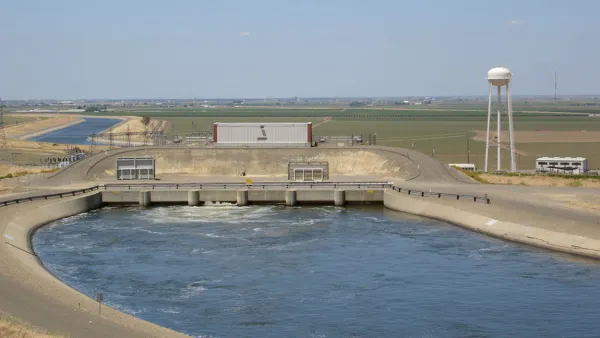
$13 Billion in Water Bonds Headed for the California Ballot in 2018
The legislature placed a $4.1 billion water bond on the ballot in June while a privately funded initiative hopes to qualify an $8.9 billion water bond for the November ballot. The state measure would also fund parks and trails.
Can California's Delta Plan Balance Infrastructure Investment with Environmental Protections?
Jerry Meral, Deputy Secretary of Resources in California, discusses balancing myriad stakeholders and goals in pushing for Governor Brown's controversial Sacramento–San Joaquin River Delta plan.

Planetizen Federal Action Tracker
A weekly monitor of how Trump’s orders and actions are impacting planners and planning in America.

The state-sanctioned urbicide of Austin
People don’t kill cities. Freeways do.

US to reduce Colorado River water deliveries to Mexico
A new Colorado Treaty amendment reduces Mexico’s Colorado River water allocation by 250,000 acre feet.

Mamdani overhauls NYC's Vision Zero plan with 100 new policy goals
The overhaul aims to reduce traffic deaths and make streets safer for pedestrians, cyclists and drivers through lower speed limits, new safety infrastructure and more.

Amtrak not solely to blame for New Jersey commuter rail's unreliability, report finds
A new study from the Garden State Initiative found that NJ Transit’s budget grew 20% across a 4 year period, but reliability declined significantly over the same period.

EPA erases limits on planet-warming pollution from power plants
Under Monday’s plan, power plants would still have some limits on how much mercury, arsenic and other contaminants they can emit.

FREE Course: Walkable City 1: Why Walkability?
After describing his path towards focusing on walkability as the essence of good planning, Jeff Speck marches through his five principal reasons for making more walkable places.
Reinventing Malls: Planning Alchemy—Turning Gray Fields Into Gold
The course focuses on the opportunities and imperatives that shape reinvention of mall sites.

Eagle County Government
Harvard University Graduate School of Design
Nashville Planning Department
The Architects Foundation
University of Cincinnati Online
The Pocatello Development Authority
The Urban Renewal Agency of the City of Pocatello
Journal of the American Planning Association