Industry experts project growth for electric buses, which could have big impacts on air quality and emissions in cities around the world.


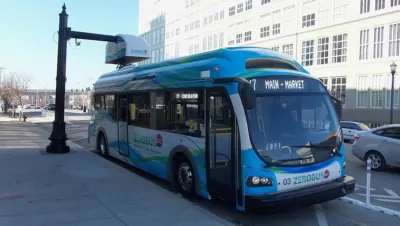
Los Angeles, Seattle, and New York have all made commitments to purchase battery-electric buses (BEBs) in the coming years. These completely electric vehicles are being manufactured by a number of suppliers including: Proterra, Volkswagen, Volvo and Hyundai. "As these companies scale up, it creates more and more of an actual industry, a supply chain of parts and expertise that aspiring new companies can draw on. With scale and learning come falling costs," David Roberts writes for Vox.
In addition to providing the possibility of curbing emissions, BEBs get air pollution out of the densest parts of cities. "For one thing, the world is rapidly urbanizing and particulate pollution — especially from diesel, the fuel of choice for older buses — is increasingly seen as a health crisis," writes Roberts. Without the large engines required in diesel buses, BEBs can ride lower to the ground, electric motors also provide a quieter ride.
Read the full story: Electric buses are coming, and they’re going to help fix 4 big urban problems


The Climate Outlook for 2024
This year could mark a turning point for climate policy and energy systems.
Ways the EPA Can Still Fight Climate Change
Despite the Supreme Court’s recent decision to limit the EPA’s ability to regulate emissions from power plants, the agency still has a range of tools at its disposal for enforcing pollution controls and reducing harmful emissions.
Exhaust-Free City Centers by 2030!
It’s time to harness technology for cleaner, healthier, and safer cities.

Planetizen Federal Action Tracker
A weekly monitor of how Trump’s orders and actions are impacting planners and planning in America.

California plans to bury El Niño’s downpour
If the state plays its cards right, it may be able to store a billion acre-feet of El Niño’s water in aquifers.

Desperate measures: Advocates weigh draining Lake Powell to fill Colorado River
Draining the reservoir could reduce evaporation losses by a couple hundred thousand acre-feet.

California city breaks ground on transit connector
The project includes three mobility hubs and a pedestrian bridge.

After public outcry, Massachusetts city releases housing development tracker
Cambridge’s tracker currently shows 250 housing projects in various stages of development.

40 years after approval, Chicago breaks ground on new park
The park honors Jean Baptiste Point du Sable, the city’s first permanent non-native settler.

FREE Course: Walkable City 1: Why Walkability?
After describing his path towards focusing on walkability as the essence of good planning, Jeff Speck marches through his five principal reasons for making more walkable places.
Reinventing Malls: Planning Alchemy—Turning Gray Fields Into Gold
The course focuses on the opportunities and imperatives that shape reinvention of mall sites.

City of Rosemead
Rutgers University, Edward J. Bloustein School of Planning and Public Policy
One Hundred Miles
Hunter College, City University of New York (CUNY)
The Architects Foundation
University of Cincinnati Online
City of Cambridge
Montrose County
The Pocatello Development Authority