An opinion piece points out the inequities of growth in contemporary Philadelphia.



An opinion article by Paul R. Levy, written for the Philadelphia Inquirer, calls attention to the dichotomy of growth in Philadelphia—it's a story that will sound familiar in many other cities around the country.
On one hand, "Philadelphia is enjoying its longest economic expansion of the last 50 years, adding 55,100 jobs since 2010, growing in all but one year since 2005." Record jobs have been added around the city, with jobs and investment centered around Center City, but with help from University City, the Navy Yard, and Temple's campuses, according to Levy.
On the other hand, Philadelphia has a 25.7 poverty rate, which places it among the highest rates for large cities in the United States. "The downtown story is about millennials and empty-nesters moving in, families having children," writes Levy. "But in many other neighborhoods, working and middle-class families still leave for the suburbs."
A Downtown-centric revival will sound familiar in Detroit and Cleveland, for instance, where rising job growth and development investment tides have not yet lifted all boats. As levy admits, it's also the story of Dickens’ Tale of Two Cities. In Philadelphia, writes Levy, "[the] story is not a tale of two cities; it’s a tale of one city not growing fast enough to address problems we’ve inherited, when we can count less on higher levels of government for help."
Read the full story: Sure, Philly is growing. But not fast enough | Opinion


Is Inequality Destroying American Cities?
A recent video claimed that high income inequality is the “Thing That Will Destroy Our Cities.” Is this true?
Not All Affordable Housing Shortages Are Alike
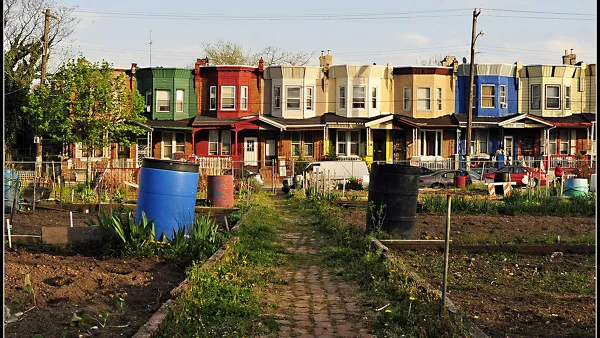
The city of Philadelphia shows that not all affordability crises are created with the same mix of supply and demand.
A Chronicle of Inequality—Starting with Memphis and Houston
Places Journal has launched a series titled "The Inequality Chronicles." Expect high-quality longform articles.

Planetizen Federal Action Tracker
A weekly monitor of how Trump’s orders and actions are impacting planners and planning in America.

Amtrak, CN end decades-long dispute with eight-year agreement
The new operating agreement establishes an updated framework for the companies to work together, including processes to resolve disputes.

Judges permit Denver to divert 77,000 acre feet from the Colorado River for reservoir expansion
Overuse and climate change have caused the Colorado River’s water levels to plummet.

NYC DOT wants faster, more permanent street upgrades
The city is examining ways to build more concrete infrastructure without getting entangled in 'decades-long' projects.

'Something we’ve never seen before:' rising utility rates could strain city finances nationwide
Data centers, climate change and other factors have caused utility rates in the United States to increase by 38% since 2020.

Trump to overrule local leaders, lease millions of acres of America’s Pacific Island territories’ seafloors to mining companies
International law says that the Indigenous people of America’s territories have a right to prior and informed consent regarding projects that impact their countries.

FREE Course: Walkable City 1: Why Walkability?
After describing his path towards focusing on walkability as the essence of good planning, Jeff Speck marches through his five principal reasons for making more walkable places.
Reinventing Malls: Planning Alchemy—Turning Gray Fields Into Gold
The course focuses on the opportunities and imperatives that shape reinvention of mall sites.

Harvard University Graduate School of Design
KFH Group Inc.
Greater Baltimore Committee
The Architects Foundation
University of Cincinnati Online
The Pocatello Development Authority
The Urban Renewal Agency of the City of Pocatello