Key features of Ford's plans for a fleet of shared autonomous vehicles potentially telegraph how the first wave of at-scale adoption will take place.


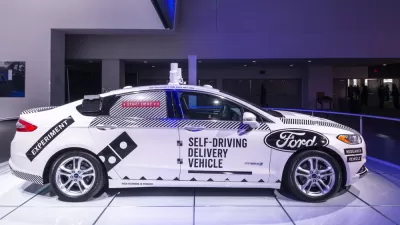
Details are emerging about Ford Motor Company's plans for an autonomous vehicle fleet expected for delivery in 2021. Jim Farley, Ford's executive vice president and president of global markets, recently gave new details to the Financial Times (paywall), and it looks like Ford is thinking big for 2021.
Jon Fingas shares the details of that interview and what's already know about the company's autonomous vehicle plans. Fingas seems especially interested in the idea that Ford will be operating its own fleet of driverless cars—not partnering with Lyft or some other operator.
Farley also stressed that this would be a truly Ford-run service. While Ford does have self-driving car partnerships with companies like Lyft, it intends to "own the fleet" for its own services. That's somewhat similar to Renault-Nissan, but a sharp contrast with Jaguar Land Rover, Volvo and others focused on selling vehicles to outside services.
Also of note to planners: According to Fingas, Ford is preparing for a decline in vehicle ownership. "Its leadership has repeatedly talked about preparing for the decline of car ownership, and that means a shift toward services (such as its on-demand commuter vans) instead of pure car sales."
Read the full story: Ford's self-driving car network will launch 'at scale' in 2021
The Ethics of Autonomous Car Testing
In the wake of multiple fatal crashes involving Tesla's self-driving mode, ethicists suggest the need for a robust set of regulations governing the testing of AVs before more of them hit the road.
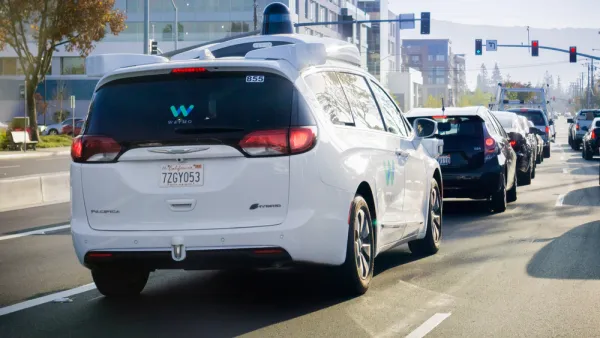
TEDx: How Will Autonomous Vehicles Transform Cities?
Nico Larco presents a TEDx Talk on the impacts AVs will have on cities, including impacts on land use, land valuation, and the environment. AVs are more than just a transportation issue, and planners need to prepare for the coming changes.

Self-Driving Cars Hog Power
Self-driving cars process a tremendous amount of data to pilot themselves through crowded streets. That computing power needs electricity, and lots of it.

Planetizen Federal Action Tracker
A weekly monitor of how Trump’s orders and actions are impacting planners and planning in America.

California plans to bury El Niño’s downpour
If the state plays its cards right, it may be able to store a billion acre-feet of El Niño’s water in aquifers.

Desperate measures: Advocates weigh draining Lake Powell to fill Colorado River
Draining the reservoir could reduce evaporation losses by a couple hundred thousand acre-feet.

US buildings threatened, destroyed by fires set to triple by 2060
Researchers found a high fire risk for socioeconomically vulnerable neighborhoods in the American West.

LA residents may be allowed to paint their own crosswalks
Councilwoman Katy Yaroslavsky put out a motion instructing the Los Angeles Department of Public Transportation to study the feasibility of allowing volunteers to paint crosswalks.

Dallas moves to overhaul its zoning code
The city's zoning reform will allow more multi-family and mixed-use developments.

FREE Course: Walkable City 1: Why Walkability?
After describing his path towards focusing on walkability as the essence of good planning, Jeff Speck marches through his five principal reasons for making more walkable places.
Reinventing Malls: Planning Alchemy—Turning Gray Fields Into Gold
The course focuses on the opportunities and imperatives that shape reinvention of mall sites.

City of Rosemead
Rutgers University, Edward J. Bloustein School of Planning and Public Policy
One Hundred Miles
Hunter College, City University of New York (CUNY)
The Architects Foundation
University of Cincinnati Online
City of Cambridge
Montrose County
The Pocatello Development Authority