BART and VTA officials must come to an agreement about whether to use a single- or double-bore tunnel for transit extension in San Jose, and time is running out.


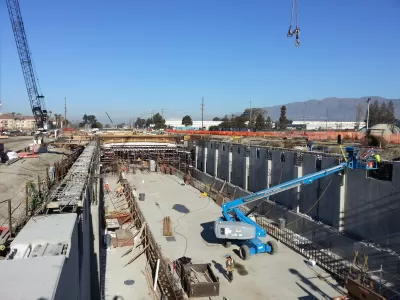
The four-station San Jose BART extension will be one of the largest extensions the system has ever received, but what those stations will look like is still up for debate. "Not only will it link the economic powerhouse of Silicon Valley to the East Bay and San Francisco, it will also connect BART to Caltrain and high-speed rail, transforming San Jose into a regional transit hub unlike any the Bay Area has ever seen," Erin Baldassari and Emily Deruy write for The Mercury News.
The decision comes down to the difference between a twin-bore or single-bore solution for tunneling. The more common twin bore would cut two tubes for trains to run on parallel tracks, with a platform in the middle. The single-bore alignment would cut one large tunnel and put the two tracks above one another. "To get funding and start construction in the next two years, the VTA’s governing board needs to make its decision by April 5, and BART must approve that recommendation by April 26," Baldassari and Deruy write.
The two approaches have different features, the single-bore solution, which the Valley Transportation Authority (VTA) favors, would be a deeper cut and disrupt the street and utilities less during the construction period. A double-bore tunnel would have a larger platform and, because it wouldn't be different from other tunnels in the system, it would be less likely to cause confusion in the event of an emergency evacuation, BART officials contend.
FULL STORY: Time is ticking on $1.5 billion BART decision paving way to San Jose

New South Bay BART Stations See Disappointing Ridership
Introduced during the pandemic in an area where many residents now work remotely, the new stations have failed to attract new commuters.
BART to Open Extension to Milpitas Station in December
Valley Transportation Authority (VTA) officials are optimistic that a new BART station, with connections to VTA light rail, will open ahead of schedule.
Santa Clara County to Vote on Tax for Silicon Valley BART Extension
The Santa Clara Valley Transportation Authority unanimously approved the 30-year, half-cent transportation sales tax for the countywide ballot in November. $1.5 billion in tax revenues would go to Phase II of a BART extension in the Silicon Valley.

Planetizen Federal Action Tracker
A weekly monitor of how Trump’s orders and actions are impacting planners and planning in America.

The state-sanctioned urbicide of Austin
People don’t kill cities. Freeways do.

US to reduce Colorado River water deliveries to Mexico
A new Colorado Treaty amendment reduces Mexico’s Colorado River water allocation by 250,000 acre feet.

5 New England states march closer to 800 megawatt wind energy project
Securing federal approval for the project may be complicated under the Trump administration, which has historically been hostile towards domestic wind power.

Baltimore to break ground on $50 million Transit Priority Project
The project will bring faster bus trips, safer streets and better bike connections to Baltimore.

Airbnb launches $250 million 'last-dollar financing' housing accelerator, makes first investment in Austin
The company will put $6.4 million towards affordable housing development in Texas’ capital.

FREE Course: Walkable City 1: Why Walkability?
After describing his path towards focusing on walkability as the essence of good planning, Jeff Speck marches through his five principal reasons for making more walkable places.
Reinventing Malls: Planning Alchemy—Turning Gray Fields Into Gold
The course focuses on the opportunities and imperatives that shape reinvention of mall sites.


Eagle County Government
Harvard University Graduate School of Design
Nashville Planning Department
The Architects Foundation
University of Cincinnati Online
The Pocatello Development Authority
The Urban Renewal Agency of the City of Pocatello
Journal of the American Planning Association